Permit to Pump Template for Dewatering
Written from experience on CTRL, Crossrail and Network Rail
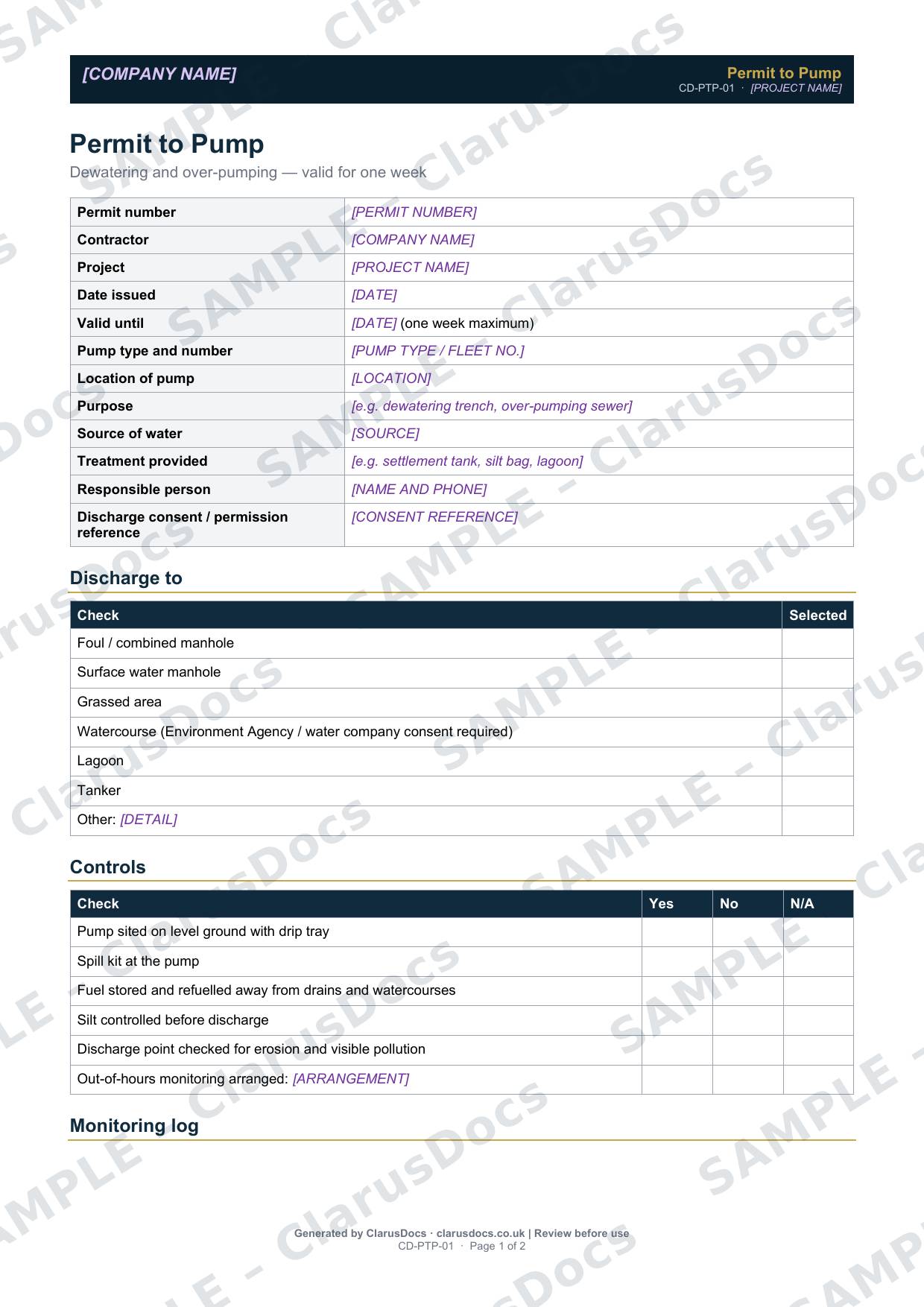
This permit to pump template controls dewatering and over-pumping on site, so that silty or contaminated water does not end up in a drain, ditch or river. It records where the water comes from, how it is treated, where it goes and the permission that allows the discharge.
 See what you get →
Completed except the facts only you know
£25 + VAT
£30 inc. VAT
- Fills in: The permit details, from the works you describe.
- Stays [TO CONFIRM]: Permit number, named issuers and emergency contacts. Signatures, times and readings are left blank for issue.
- A competent person must review before use.
- Company logo in header
- Delivered in minutes
- Word document (.docx)
Template
£9 + VAT
£10.80 inc. VAT
Blank permit — fill in yourself
- Word document (.docx)
- Guidance notes included
- Instant download
- Use on any project
Prices exclude VAT: UK customers pay 20% VAT; VAT is not charged for customers outside the UK.All documents are drafts. Placeholders marked [TO CONFIRM] must be completed with your site-specific details. A competent person must review before use on site.
Why it matters
When the dispute arrives, the question is always: what did you have in place and when? This document is the answer.
What it's for
Pumping water out of an excavation looks harmless, but silty discharges kill fish and plants, block drains, and can lead to enforcement action and clean-up costs. A permit to pump makes someone check the pump, the discharge point and the permission before the pump is switched on, and keeps a log of checks while it runs.
When you need it
Whenever water is pumped from excavations, chambers, ponds or flooded areas, or when a sewer is over-pumped while a connection is made. The permit is valid for one week, so long-running pumping needs a new permit each week.
Who signs it
The issuer signs to confirm the controls and the discharge permission are in place. The responsible person signs to accept the permit and carry out the checks. The issuer cancels it when pumping stops and the area is left clean.
What's inside
- Permit details, pump type and location, purpose and water source
- Treatment provided, such as a settlement tank, silt bag or lagoon
- The discharge permission reference
- Discharge point options, from foul manhole to watercourse or tanker
- Controls for drip trays, spill kits, fuel storage, silt and out-of-hours checks
- A seven-entry monitoring log, a declaration and signed permit stages
FAQ
- Do I need permission to discharge water?
- Usually, yes. Depending on where the water goes, you may need permission from the Environment Agency (or Natural Resources Wales, SEPA or NIEA), the water company, or the landowner. Enter the reference on the permit before pumping starts.
- Can I pump into a surface water drain?
- Only with permission, and only if the water is clean. Surface water drains often lead straight to a watercourse.
- What counts as treatment?
- Anything that removes silt before discharge, such as a settlement tank, silt bag or lagoon. Check the discharge is running clear and record it in the log.
- What is [TO CONFIRM]?
- Details only you know, such as the permit number, named issuers and emergency contacts. We never guess these. They appear as highlighted [TO CONFIRM] placeholders, and the permit opens with a list of every one. Signatures, times and readings are left blank, to be completed when the permit is issued.
- Can I edit the document?
- Yes. Both options are Word documents you can edit freely.
- Do I still need to review it?
- Yes. A competent person must check every document against the actual site and works before it is used. ClarusDocs gives you a complete first draft, not a substitute for that check.
Related documents
- Drainage Excavation RAMSThe method statement and risk assessment for digging trenches and laying drains
- Pre-Backfill Inspection ChecklistThe check that pipes, bedding and surround are right before the trench is filled
- Drainage Pressure Test RecordThe air or water test record that proves new drains don’t leak
- Service Search and CAT Scan RecordProof that services were searched for and scanned before digging
- Confined Space Risk AssessmentStarts with the first question: can entry be avoided?
- Confined Space Rescue PlanThe rescue plan that has to be in place before anyone goes in