Service Search and CAT Scan Record
Written from experience on CTRL, Crossrail and Network Rail
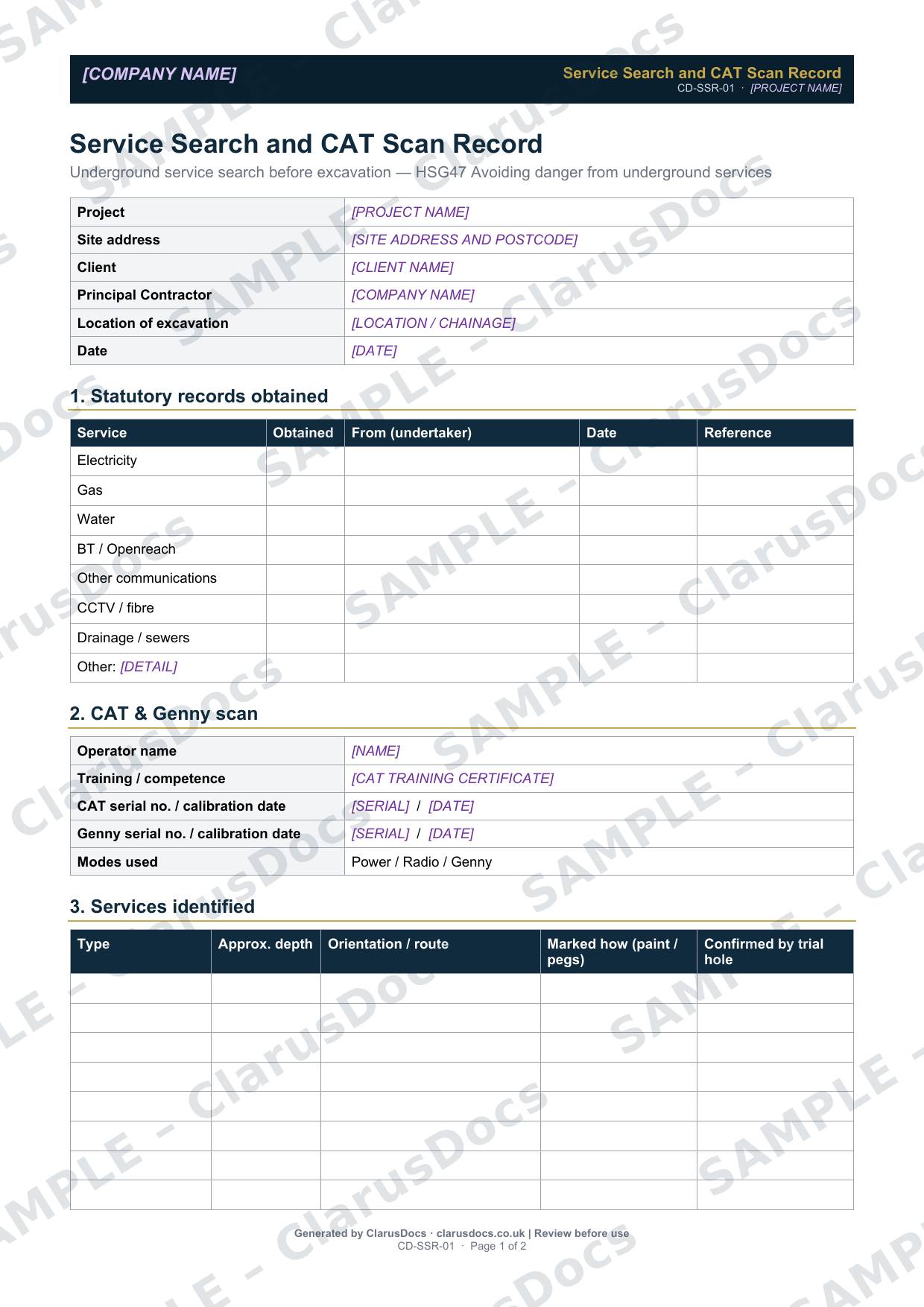
This service search and CAT scan record shows that the underground services at an excavation were searched for and scanned before digging: which utility records were obtained, who scanned the area with which equipment, what was found, and how it was marked.
 See what you get →
Completed except the facts only you know
£25 + VAT
£30 inc. VAT
- Fills in: Header details and the items to check for your project.
- Stays [TO CONFIRM]: References, names and locations you haven’t given us. Results, readings, dates and signatures are left blank.
- A competent person must review before use.
- Company logo in header
- Delivered in minutes
- Word document (.docx)
Template
£9 + VAT
£10.80 inc. VAT
Blank form — fill in yourself
- Word document (.docx)
- Guidance notes included
- Instant download
- Use on any project
Prices exclude VAT: UK customers pay 20% VAT; VAT is not charged for customers outside the UK.All documents are drafts. Placeholders marked [TO CONFIRM] must be completed with your site-specific details. A competent person must review before use on site.
What it's for
HSE guidance HSG47, Avoiding danger from underground services, sets out a safe system built on plans, locating and safe digging. The permit to dig authorises the dig. This CAT scan record is the evidence behind it, showing that the records were obtained, the scan was done by a trained operator with calibrated equipment, and the services found were marked on the ground and on the drawing.
When you need it
Before every excavation where services could be present, and before the permit to dig is issued.
Who signs it
The competent person who carried out the scan, and the site manager.
What's inside
- Location of the excavation and the date
- Statutory records obtained for each utility, with source, date and reference
- CAT and Genny operator, training, serial numbers, calibration dates and modes used
- A table of services identified: type, approximate depth, route, how they were marked, and trial hole confirmation
- Checks that services are marked on the ground and the drawing, and the permit to dig reference
- Notes, such as services not traced or areas not scanned
- Sign-off
FAQ
- Is a CAT scan enough on its own?
- No. Utility records, scanning and hand-dug trial holes all work together. Some services, such as plastic pipes, may not be detected by a cable locator.
- Do the scan results go on the permit to dig?
- The permit to dig refers to this record. The template has a field for the permit reference.
- What should go in the notes?
- Anything that limits the scan, such as areas not scanned, services that could not be traced, or assumptions made.
- What is [TO CONFIRM]?
- Details only you know, such as references, names and locations. We never guess these. They appear as highlighted [TO CONFIRM] placeholders, and the form opens with a list of every one. Results, readings, dates and signatures are left blank for completion at the time.
- Can I edit the document?
- Yes. Both options are Word documents you can edit freely.
- Do I still need to review it?
- Yes. A competent person must check every document against the actual site and works before it is used. ClarusDocs gives you a complete first draft, not a substitute for that check.
Related documents
- Drainage Excavation RAMSThe method statement and risk assessment for digging trenches and laying drains
- Pre-Backfill Inspection ChecklistThe check that pipes, bedding and surround are right before the trench is filled
- Drainage Pressure Test RecordThe air or water test record that proves new drains don’t leak
- Permit to PumpApproval to pump out water, with where it goes and how silt is controlled
- Permit to DigSign-off that buried services are found and marked before anyone breaks ground
- Pre-Start Work Package ChecklistCheck everything is ready before a package starts — not after