Groundworks Toolbox Talk Pack
Written from experience on CTRL, Crossrail and Network Rail
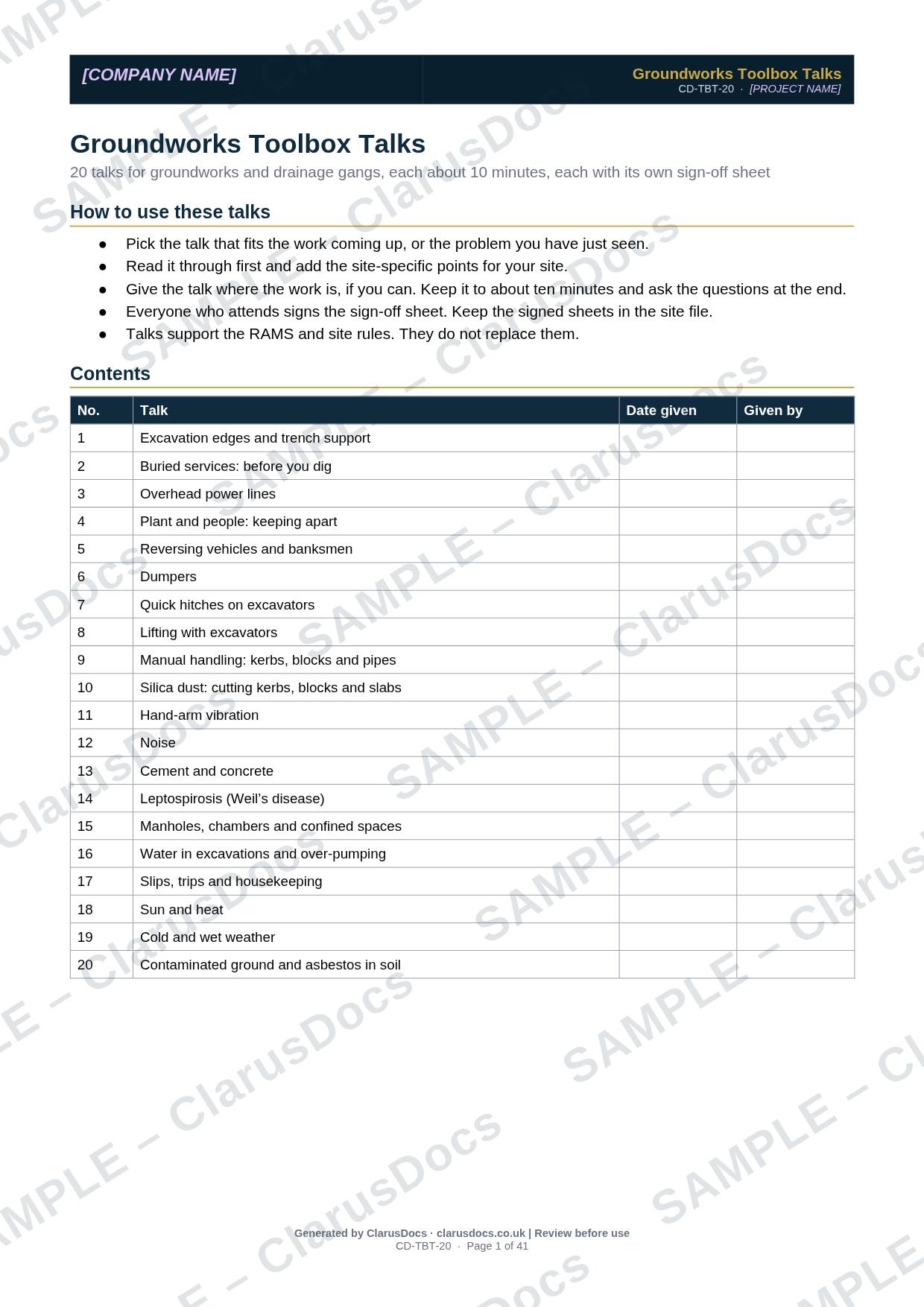
This groundworks toolbox talk pack gives you 20 ready-to-give talks in one Word document, each about ten minutes, each with key points, questions to check understanding, a link to the HSE or official guidance it draws on, and its own sign-off sheet.
 See what you get →
Template
£29 + VAT
£34.80 inc. VAT
Blank toolbox talk — fill in yourself
- Word document (.docx)
- Guidance notes included
- Instant download
- Use on any project
Prices exclude VAT: UK customers pay 20% VAT; VAT is not charged for customers outside the UK.All documents are drafts. Complete the placeholders with your own details, and have a competent person review them before use.
What it's for
Regular short talks keep the main risks of groundworks in front of the gang: excavations, buried services, plant, dust, vibration and noise. A signed sheet for each talk records who was briefed on what, and when.
When you need it
At the start of a shift or a new activity, after an incident or near miss, or as a planned programme through the job.
Who signs it
The person giving the talk, and everyone who attends.
What's inside
- 20 talks: excavation edges and support; buried services; overhead power lines; plant and people; reversing and banksmen; dumpers; quick hitches; lifting with excavators; manual handling
- Silica dust; hand-arm vibration; noise; cement and concrete; leptospirosis; manholes and confined spaces; water in excavations and over-pumping
- Slips, trips and housekeeping; sun and heat; cold and wet weather; contaminated ground and asbestos in soil
- Each talk: why it matters, key points, a space for site-specific points and questions
- A further-reading link on each talk to the HSE or official guidance
- A sign-off sheet for each talk, with space for 20 names
- A contents page to log when each talk was given
FAQ
- How long does each talk take?
- About ten minutes, including the questions. Add your site-specific points before you give it.
- Are the figures in the talks correct?
- Figures appear only where a regulation sets them, such as the noise and vibration action and limit values and the silica exposure limit. Each talk links to the HSE or official page it draws on.
- Do toolbox talks replace the RAMS?
- No. They support the RAMS and site rules by keeping the key points fresh. The RAMS for the task is still briefed in full.
- Can I edit the talks?
- Yes. It is a Word document, so you can add to the talks, remove talks, or copy one out for a single briefing.
- What are the [PLACEHOLDERS]?
- Purple text in square brackets, such as [COMPANY NAME], marks the details you fill in. Replace each one with your own details, and remove anything that doesn’t apply, before the document is used.
- Can I edit the document?
- Yes. It’s a Word document you can edit freely.
- Do I still need to review it?
- Yes. A competent person must check every document against the actual site and works before it is used. ClarusDocs gives you a complete first draft, not a substitute for that check.
Example: a filled-in sign-off sheet
How the top of a talk and its sign-off might look once given.
Example only: illustrative content, not from a real project.
- Talk
- Talk 10: Silica dust: cutting kerbs, blocks and slabs
- Presented by
- Site supervisor, at the kerb-laying area, 07:45 on a Monday
- On this site
- Kerbs on the north footway are cut with the petrol saw: water bottle full before every cut, FFP3 masks from the welfare cabin, no dry sweeping.
- Signed
- Six operatives and the plant operator signed the sheet.
- Concern raised
- The saw’s water bottle leaks. Action: replacement ordered the same day.
How to give a toolbox talk
- Pick the talk that fits the work coming up or a problem you have just seen.
- Read it through and add the site-specific points for your site.
- Give it where the work is, if you can, and keep it to about ten minutes.
- Ask the questions at the end and deal with any concerns raised.
- Have everyone sign the sheet, and keep it in the site file.
Related documents
- Drainage Excavation RAMSThe method statement and risk assessment for digging trenches and laying drains
- Pre-Backfill Inspection ChecklistThe check that pipes, bedding and surround are right before the trench is filled
- Drainage Pressure Test RecordThe air or water test record that proves new drains don’t leak
- Permit to PumpApproval to pump out water, with where it goes and how silt is controlled
- Service Search and CAT Scan RecordProof that services were searched for and scanned before digging
- Confined Space Risk AssessmentStarts with the first question: can entry be avoided?