CCTV Drainage Survey Record Template
Written from experience on CTRL, Crossrail and Network Rail
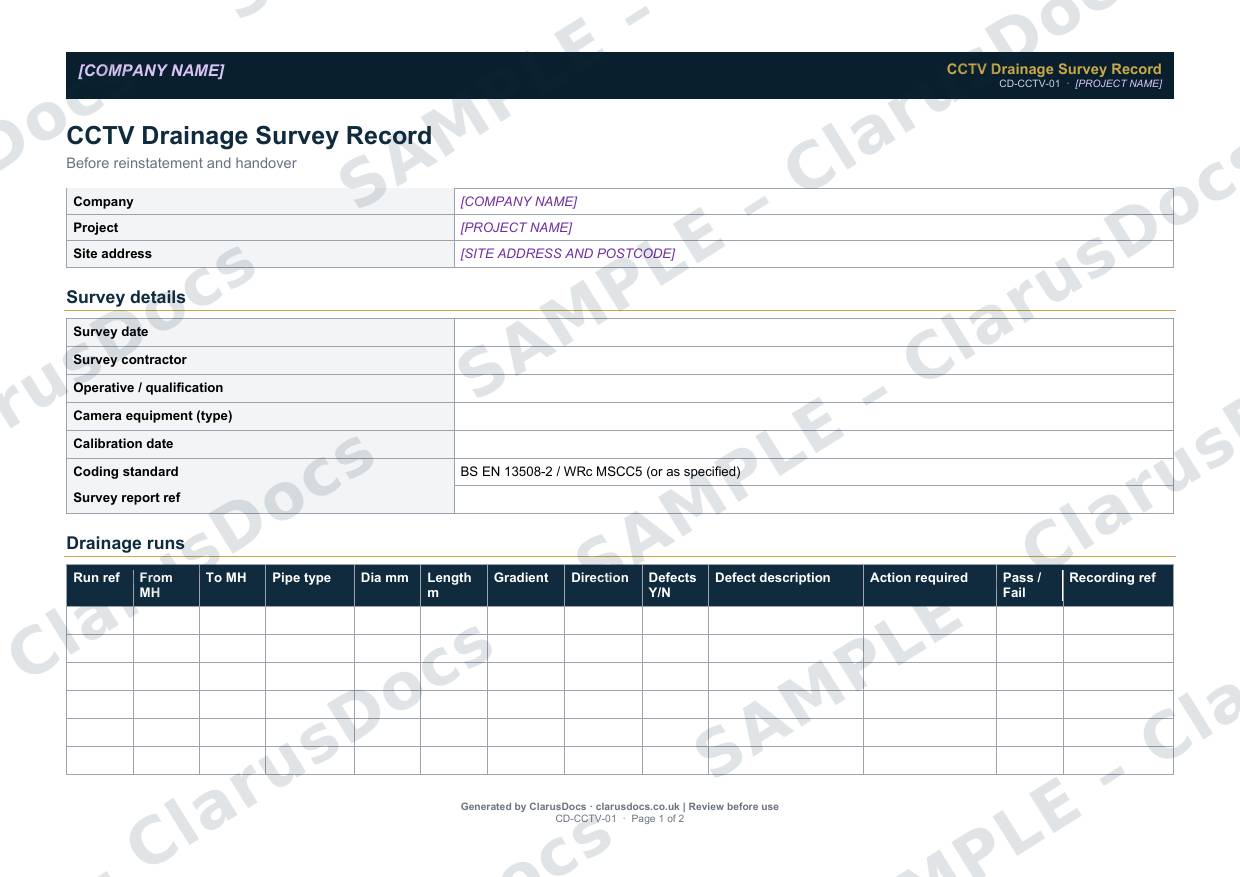
This CCTV drainage survey record is the cover sheet and run-by-run summary for a CCTV survey of new or existing drains, carried out before reinstatement and handover. It records the survey details, each run, any defects found, and the action agreed.
 See what you get →
Completed except the facts only you know
£25 + VAT
£30 inc. VAT
- Fills in: Header details and the items to check for your project.
- Stays [TO CONFIRM]: References, names and locations you haven’t given us. Results, readings, dates and signatures are left blank.
- A competent person must review before use.
- Company logo in header
- Delivered in minutes
- Word document (.docx)
Template
£9 + VAT
£10.80 inc. VAT
Blank inspection record — fill in yourself
- Word document (.docx)
- Guidance notes included
- Instant download
- Use on any project
Prices exclude VAT: UK customers pay 20% VAT; VAT is not charged for customers outside the UK.All documents are drafts. Placeholders marked [TO CONFIRM] must be completed with your site-specific details. A competent person must review before use on site.
Why it matters
When the dispute arrives, the question is always: what did you have in place and when? This document is the answer.
What it's for
A CCTV survey shows what a pressure test cannot: displaced joints, debris, deformation and back falls. Surveying before reinstatement means problems are found while they are still cheap to fix. The record turns the survey report into a clear site summary of which runs passed, which need repair, and who signed them off.
When you need it
Before reinstating over new drainage, before handover, and wherever the specification or the sewerage company requires a survey for adoption.
Who signs it
The CCTV operative, the engineer and, where required, the client.
What's inside
- Survey details: date, contractor, operative qualification, camera equipment, calibration and coding standard
- A landscape table for each run: manholes, pipe type, diameter, length, gradient, direction, defects, action, result and recording reference
- Three defect action categories: immediate action, repair before handover, and record and monitor
- A note on coding standards and adoption requirements
- Sign-off for up to three parties
FAQ
- Which coding standard is used?
- Whatever the specification requires. The template defaults to BS EN 13508-2 or the WRc Manual of Sewer Condition Classification (MSCC5).
- Do the action categories replace the defect coding?
- No. Defects are coded in the survey report to the stated standard. The categories decide what happens on site.
- Is it enough for sewer adoption?
- The survey must meet the sewerage company’s own requirements. Check those before the survey is carried out.
- When should the survey be done?
- Before reinstatement, so defects can be repaired without breaking out new surfacing. A further survey before handover may also be specified.
- What is [TO CONFIRM]?
- Details only you know, such as references, names and locations. We never guess these. They appear as highlighted [TO CONFIRM] placeholders, and the inspection record opens with a list of every one. Results, readings, dates and signatures are left blank for completion at the time.
- Can I edit the document?
- Yes. Both options are Word documents you can edit freely.
- Do I still need to review it?
- Yes. A competent person must check every document against the actual site and works before it is used. ClarusDocs gives you a complete first draft, not a substitute for that check.
Related documents
- Drainage Pressure Test RecordThe air or water test record that proves new drains don’t leak
- Master Inspection and Test PlanEvery activity, every control point — agreed before work starts
- Concrete Cube Test RegisterEvery cube, every result — checked against BS EN 206
- Snagging ListEvery snag at completion — prioritised, owned and closed
- Pre-Backfill Inspection ChecklistThe check that pipes, bedding and surround are right before the trench is filled
- Pile Record SheetOne sheet per pile — installation, concrete, cage and integrity test