Concrete Cube Test Register Template
Written from experience on CTRL, Crossrail and Network Rail
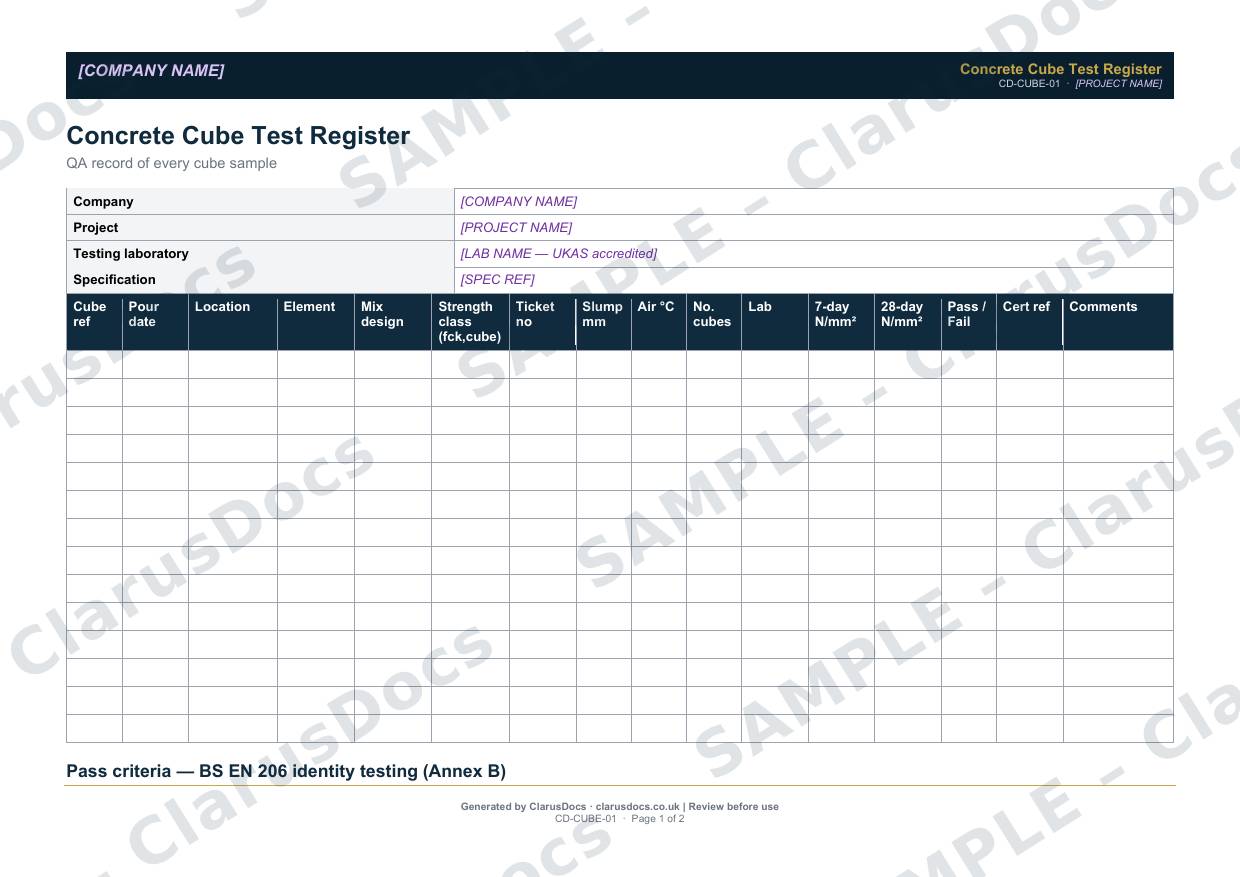
This concrete cube test register records every cube sample taken on site, from the pour and the delivery ticket to the 7-day and 28-day results, and whether each one passed. It is the QA record that shows the concrete met its specified strength.
 See what you get →
Completed except the facts only you know
£25 + VAT
£30 inc. VAT
- Fills in: The register header for your project.
- Stays [TO CONFIRM]: Names and references you haven’t given us. Entry rows are left blank.
- A competent person must review before use.
- Company logo in header
- Delivered in minutes
- Word document (.docx)
Template
£9 + VAT
£10.80 inc. VAT
Blank register — fill in yourself
- Word document (.docx)
- Guidance notes included
- Instant download
- Use on any project
Prices exclude VAT: UK customers pay 20% VAT; VAT is not charged for customers outside the UK.All documents are drafts. Placeholders marked [TO CONFIRM] must be completed with your site-specific details. A competent person must review before use on site.
What it's for
If a strength result fails, the first questions are which pour it came from, what was sampled, and what the other results show. A single register answers those questions straight away. It also shows the client and the engineer that sampling and testing were carried out throughout the job, not just when someone asked.
When you need it
From the first structural pour, updated each time cubes are made and again when the laboratory results arrive.
Who signs it
The QA engineer or site engineer responsible for concrete testing.
What's inside
- Project, testing laboratory and specification references
- A landscape register with cube reference, pour date, location, element, mix, strength class, ticket number, slump, air temperature, number of cubes, laboratory, 7-day and 28-day results, pass or fail, certificate reference and comments
- The BS EN 206 identity testing criteria for judging 28-day results
- Steps to take if a result fails, including raising a non-conformance report and considering core testing
- QA sign-off
FAQ
- Is the 7-day result enough?
- No. It is an early indication only. Compliance is usually judged at 28 days, unless the specification states another age, such as 56 days for some cement types.
- What if the specification is stricter than BS EN 206?
- The specification takes precedence. The template includes a note on this.
- What happens if a result fails?
- Notify the engineer or Supervisor, raise a non-conformance report, stop further pours with that mix until the cause is known, and agree further investigation, such as cores to BS EN 12504-1.
- Should the laboratory be UKAS accredited?
- The template asks for a UKAS accredited laboratory, which most specifications require. Check your specification.
- What is [TO CONFIRM]?
- Details only you know, such as names, references and dates. We never guess these. They appear as highlighted [TO CONFIRM] placeholders, and the register opens with a list of every one. The entry rows are always left blank: we never invent entries, so you record them as the work goes on.
- Can I edit the document?
- Yes. Both options are Word documents you can edit freely.
- Do I still need to review it?
- Yes. A competent person must check every document against the actual site and works before it is used. ClarusDocs gives you a complete first draft, not a substitute for that check.
Related documents
- Snagging ListEvery snag at completion — prioritised, owned and closed
- Drainage Pressure Test RecordThe air or water test record that proves new drains don’t leak
- Master Inspection and Test PlanEvery activity, every control point — agreed before work starts
- CCTV Drainage Survey RecordProve the drains are right before you reinstate over them
- Material Delivery RecordCheck it, accept it, record it — QA evidence for every delivery
- Defects RegisterTrack every notified Defect to correction — and protect your final account