COSHH Assessment Template
Written from experience on CTRL, Crossrail and Network Rail
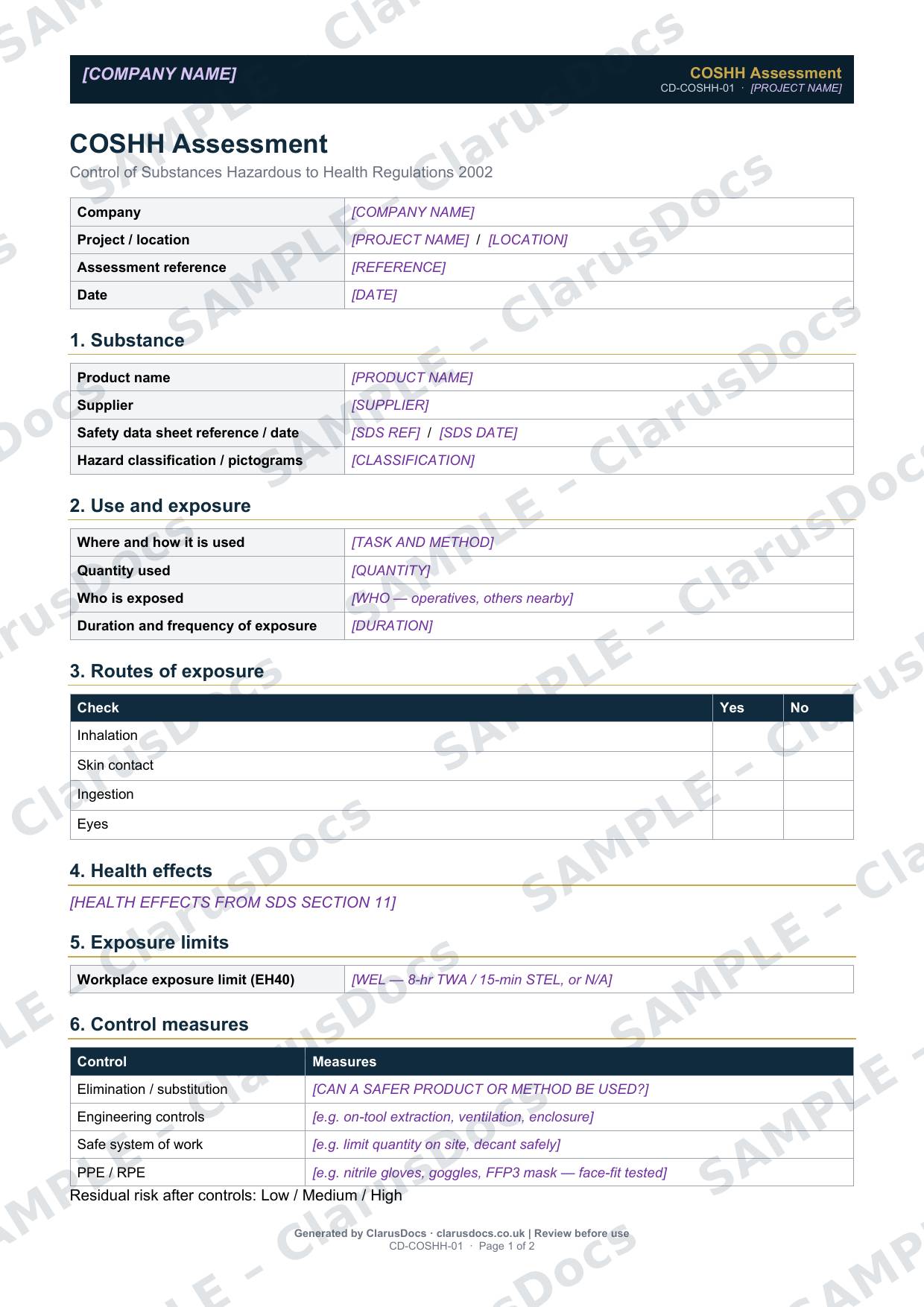
This COSHH assessment template records how a hazardous substance will be used safely on site: what it is, who could be exposed and how, the exposure limits, the controls, and what to do in an emergency. It follows the Control of Substances Hazardous to Health Regulations 2002.
 See what you get →
Completed except the facts only you know
£25 + VAT
£30 inc. VAT
- Fills in: Hazards, controls and risk scores before and after controls, for your task.
- Stays [TO CONFIRM]: Site address and postcode, nearest A&E, named people and contacts.
- A competent person must review before use.
- Company logo in header
- Delivered in minutes
- Word document (.docx)
Template
£9 + VAT
£10.80 inc. VAT
Blank assessment — fill in yourself
- Word document (.docx)
- Guidance notes included
- Instant download
- Use on any project
Prices exclude VAT: UK customers pay 20% VAT; VAT is not charged for customers outside the UK.All documents are drafts. Placeholders marked [TO CONFIRM] must be completed with your site-specific details. A competent person must review before use on site.
What it's for
Cement, solvents, resins, fuels, release agents and the dust from cutting and drilling can all cause lasting harm, from dermatitis to lung disease. The regulations require employers to assess the risk from hazardous substances and to prevent or adequately control exposure. The assessment turns the safety data sheet into practical controls the gang can follow.
When you need it
Before a hazardous substance is used on site, and again when the product, the method or the conditions change. The safety data sheet is the starting point. It is not the assessment itself.
Who signs it
The assessor signs it, usually the supervisor or a competent person who knows the task. It should be briefed to everyone using the substance, and reviewed using the review table.
What's inside
- Substance details: product, supplier, safety data sheet reference and date, and hazard classification
- Use and exposure: task, quantity, who is exposed, duration and frequency
- Routes of exposure: inhalation, skin, ingestion and eyes
- Health effects, taken from the safety data sheet
- The workplace exposure limit from HSE’s EH40
- Controls in order: elimination or substitution, engineering controls, safe system of work, then PPE and RPE
- Emergency procedures, storage and disposal, and whether health surveillance is needed
- Sign-off and a review table
FAQ
- Is the safety data sheet enough on its own?
- No. The safety data sheet describes the product. The COSHH assessment describes how you will use it on this job and how exposure will be controlled.
- Does dust from cutting count?
- Yes. Dusts such as silica from cutting, drilling or grinding concrete, stone and blocks are hazardous substances and need assessing and controlling, usually with water suppression or on-tool extraction and suitable RPE.
- When is health surveillance needed?
- When the assessment shows there is a reasonable likelihood of an identifiable disease linked to the exposure, for example skin checks for substances that cause dermatitis. The template has a field to record the decision.
- What is [TO CONFIRM]?
- Details only you know, such as your site address and postcode, the nearest A&E, named people and contact numbers. We never guess these. They appear as highlighted [TO CONFIRM] placeholders, and the document opens with a list of every one, so you can fill them in before the assessment is signed and used.
- Can I edit the document?
- Yes. Both options are Word documents you can edit freely.
- Do I still need to review it?
- Yes. A competent person must check every document against the actual site and works before it is used. ClarusDocs gives you a complete first draft, not a substitute for that check.
Related documents
- Manual Handling AssessmentAssess lifting and carrying tasks — task, load, environment, individual
- Noise and Vibration AssessmentWork out noise and vibration exposure from tools and plant, and what to do about it
- Working at Height Risk AssessmentPlan work at height the right way round: avoid, prevent, then minimise
- Construction Health and Safety Policy PackYour health and safety policy and arrangements, ready to tailor
- Lone Working Risk AssessmentPlan how someone working alone stays safe and in contact
- Young Persons Risk AssessmentThe extra assessment needed before anyone under 18 starts on site