Working at Height Risk Assessment Template
Written from experience on CTRL, Crossrail and Network Rail
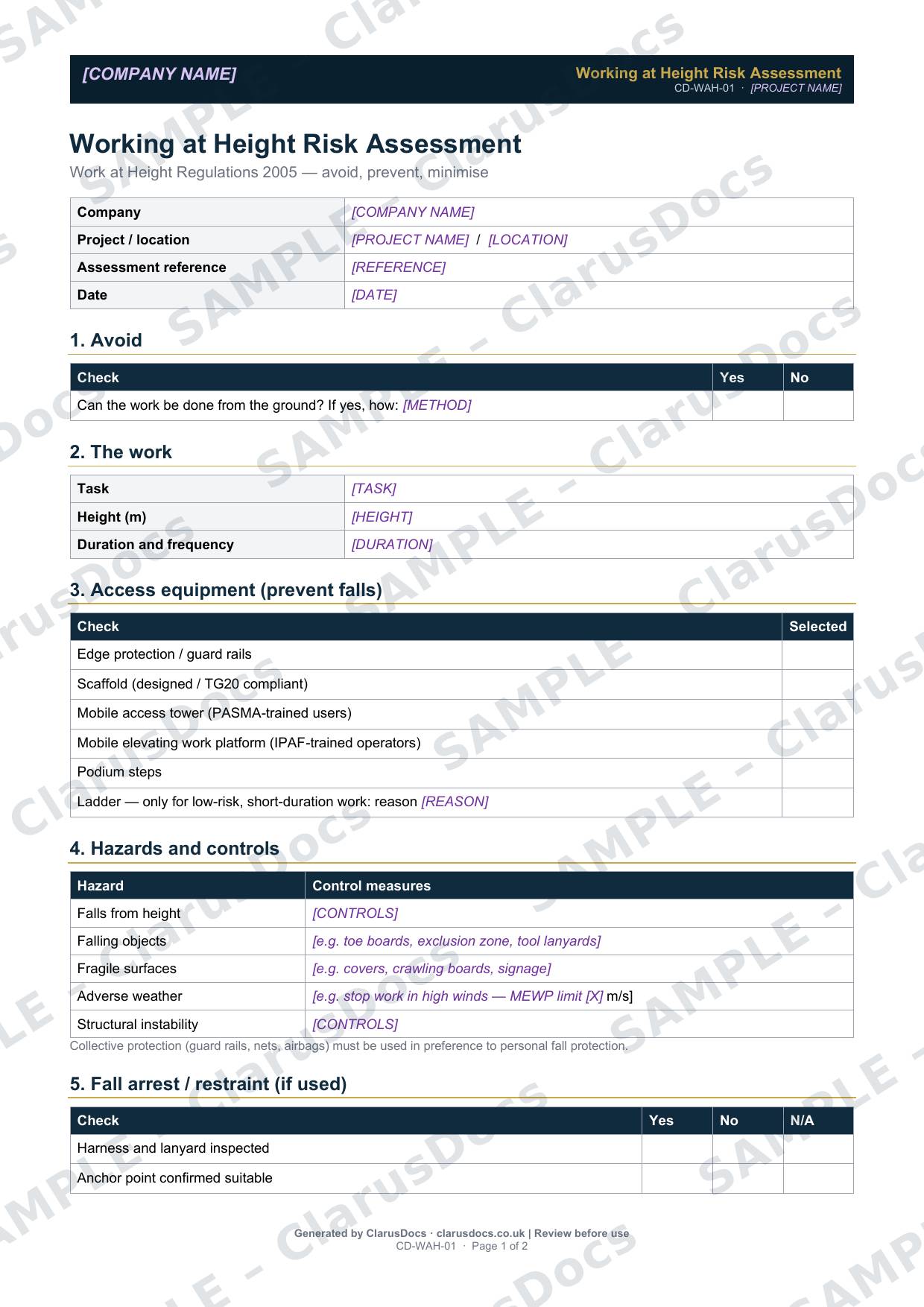
This working at height risk assessment template plans work where a fall could cause injury, following the order set by the Work at Height Regulations 2005: avoid work at height where you can, prevent falls where you cannot, and minimise the consequences if a fall could still happen.
 See what you get →
Completed except the facts only you know
£25 + VAT
£30 inc. VAT
- Fills in: Hazards, controls and risk scores before and after controls, for your task.
- Stays [TO CONFIRM]: Site address and postcode, nearest A&E, named people and contacts.
- A competent person must review before use.
- Company logo in header
- Delivered in minutes
- Word document (.docx)
Template
£9 + VAT
£10.80 inc. VAT
Blank assessment — fill in yourself
- Word document (.docx)
- Guidance notes included
- Instant download
- Use on any project
Prices exclude VAT: UK customers pay 20% VAT; VAT is not charged for customers outside the UK.All documents are drafts. Placeholders marked [TO CONFIRM] must be completed with your site-specific details. A competent person must review before use on site.
What it's for
Falls from height are one of the biggest causes of death and serious injury in construction. The template makes the assessor consider each step in turn, starting with whether the work can be done from the ground, choosing collective protection before personal equipment, and planning rescue before anyone relies on a harness.
When you need it
Before any work at height, including work near an open edge, on fragile surfaces, from ladders or towers, or in MEWPs. Review it if the method, the equipment or the conditions change.
Who signs it
The assessor signs it and briefs it to everyone involved. Record reviews in the review table.
What's inside
- Whether the work can be avoided
- The task, height, duration and frequency
- Access equipment options: edge protection, scaffold, towers, MEWPs, podium steps, and ladders only where justified
- A hazard and control table for falls, falling objects, fragile surfaces, weather and structural instability
- A note that collective protection comes before personal fall protection
- Fall arrest and restraint checks, equipment inspection and the rescue plan
- Sign-off and review
FAQ
- Can ladders still be used?
- Yes, for low-risk, short-duration work where other equipment is not justified. The template asks you to record the reason.
- Why is a rescue plan needed?
- Someone suspended in a harness after a fall must be recovered quickly. The plan for doing that has to be in place before the work starts.
- How often must scaffolds be inspected?
- Where someone could fall 2 m or more from a working platform, the Work at Height Regulations 2005 require it to be inspected after it is put up, at intervals of no more than seven days, and after anything that could affect its stability, such as bad weather. The template prompts you to record who inspects and how often.
- What is [TO CONFIRM]?
- Details only you know, such as your site address and postcode, the nearest A&E, named people and contact numbers. We never guess these. They appear as highlighted [TO CONFIRM] placeholders, and the document opens with a list of every one, so you can fill them in before the assessment is signed and used.
- Can I edit the document?
- Yes. Both options are Word documents you can edit freely.
- Do I still need to review it?
- Yes. A competent person must check every document against the actual site and works before it is used. ClarusDocs gives you a complete first draft, not a substitute for that check.
Related documents
- COSHH Assessment TemplateAssess a hazardous substance before anyone uses it
- Manual Handling AssessmentAssess lifting and carrying tasks — task, load, environment, individual
- Noise and Vibration AssessmentWork out noise and vibration exposure from tools and plant, and what to do about it
- Construction Health and Safety Policy PackYour health and safety policy and arrangements, ready to tailor
- Lone Working Risk AssessmentPlan how someone working alone stays safe and in contact
- Young Persons Risk AssessmentThe extra assessment needed before anyone under 18 starts on site