Manual Handling Risk Assessment Template
Written from experience on CTRL, Crossrail and Network Rail
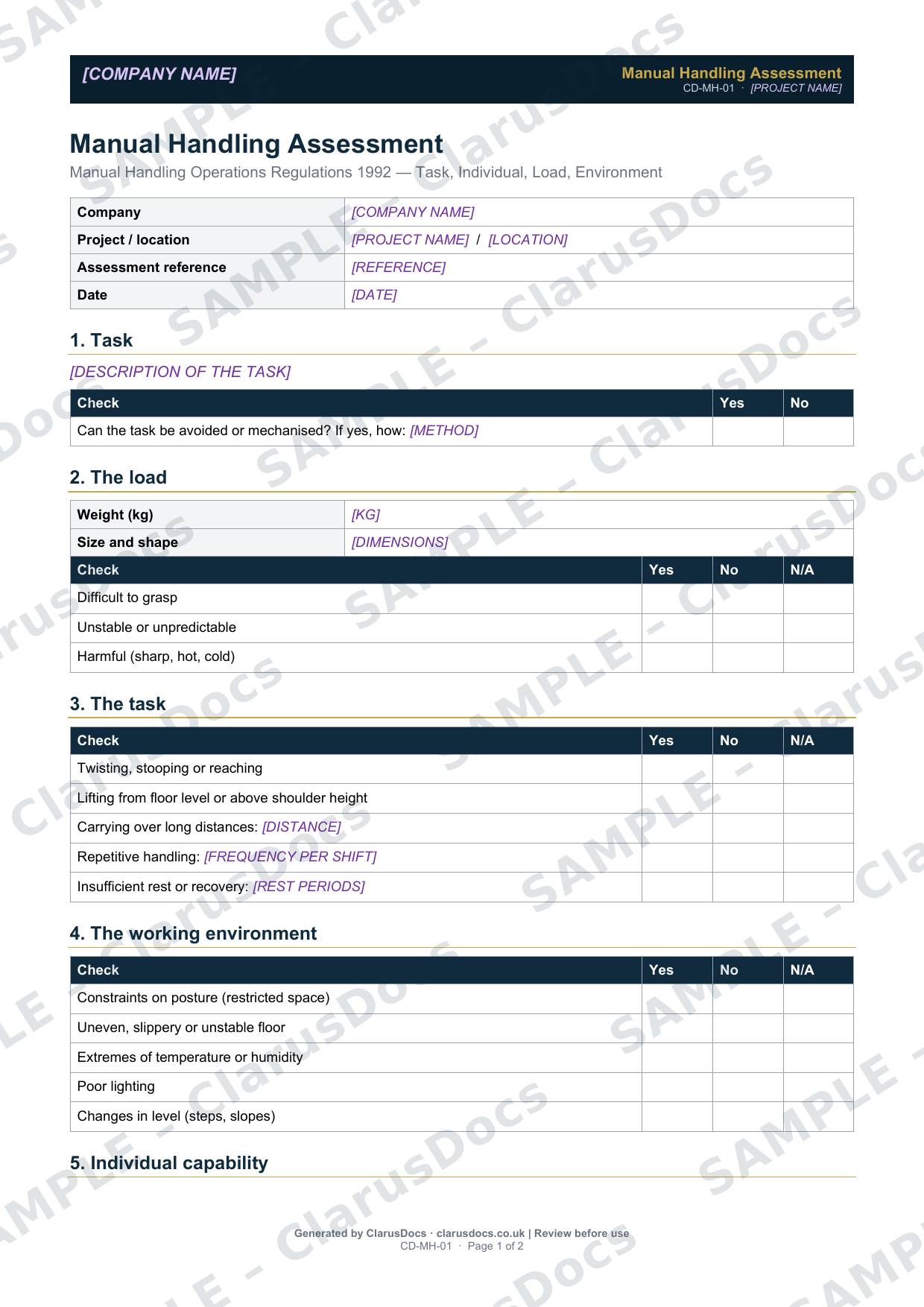
This manual handling risk assessment template looks at lifting, carrying, pushing and pulling tasks under four headings, the task, the individual, the load and the environment (TILE), and records the controls needed to reduce the risk of injury.
 See what you get →
Completed except the facts only you know
£25 + VAT
£30 inc. VAT
- Fills in: Hazards, controls and risk scores before and after controls, for your task.
- Stays [TO CONFIRM]: Site address and postcode, nearest A&E, named people and contacts.
- A competent person must review before use.
- Company logo in header
- Delivered in minutes
- Word document (.docx)
Template
£9 + VAT
£10.80 inc. VAT
Blank assessment — fill in yourself
- Word document (.docx)
- Guidance notes included
- Instant download
- Use on any project
Prices exclude VAT: UK customers pay 20% VAT; VAT is not charged for customers outside the UK.All documents are drafts. Placeholders marked [TO CONFIRM] must be completed with your site-specific details. A competent person must review before use on site.
What it's for
Kerbs, pipes, blocks, manhole rings and bagged materials make manual handling one of the most common causes of injury in groundworks. The Manual Handling Operations Regulations 1992 require employers to avoid hazardous manual handling where reasonably practicable, assess what cannot be avoided, and reduce the risk. This template works through that process for a specific task.
When you need it
Before a task involving significant manual handling starts, and when the load, method, team or conditions change. It is particularly useful for repetitive tasks such as kerb laying or block work.
Who signs it
The assessor signs it. Brief the findings to the people doing the task and record reviews in the review table.
What's inside
- Task description, and whether the task can be avoided or mechanised
- The load: weight, size, shape, grip, stability and other hazards
- The task: twisting, stooping, reaching, lifting height, carrying distance, repetition and rest
- The working environment: space, floor, temperature, lighting and changes in level
- Individual capability: strength, training, PPE and personal factors
- A risk rating and a control measures table with owners and dates
- Sign-off and review
FAQ
- Is there a maximum weight a person can lift?
- The regulations do not set one. The risk depends on the task, the individual, the load and the environment, which is why the assessment looks at all four.
- What does TILE stand for?
- Task, Individual, Load and Environment, the four factors the template asks you to consider.
- What controls work best?
- Avoiding the lift altogether, for example with a vacuum lifter for kerbs or mechanical handling for pipes. Team lifts and training come after that.
- What is [TO CONFIRM]?
- Details only you know, such as your site address and postcode, the nearest A&E, named people and contact numbers. We never guess these. They appear as highlighted [TO CONFIRM] placeholders, and the document opens with a list of every one, so you can fill them in before the assessment is signed and used.
- Can I edit the document?
- Yes. Both options are Word documents you can edit freely.
- Do I still need to review it?
- Yes. A competent person must check every document against the actual site and works before it is used. ClarusDocs gives you a complete first draft, not a substitute for that check.
Related documents
- COSHH Assessment TemplateAssess a hazardous substance before anyone uses it
- Noise and Vibration AssessmentWork out noise and vibration exposure from tools and plant, and what to do about it
- Working at Height Risk AssessmentPlan work at height the right way round: avoid, prevent, then minimise
- Construction Health and Safety Policy PackYour health and safety policy and arrangements, ready to tailor
- Lone Working Risk AssessmentPlan how someone working alone stays safe and in contact
- Young Persons Risk AssessmentThe extra assessment needed before anyone under 18 starts on site