Noise and Vibration Risk Assessment Template
Written from experience on CTRL, Crossrail and Network Rail
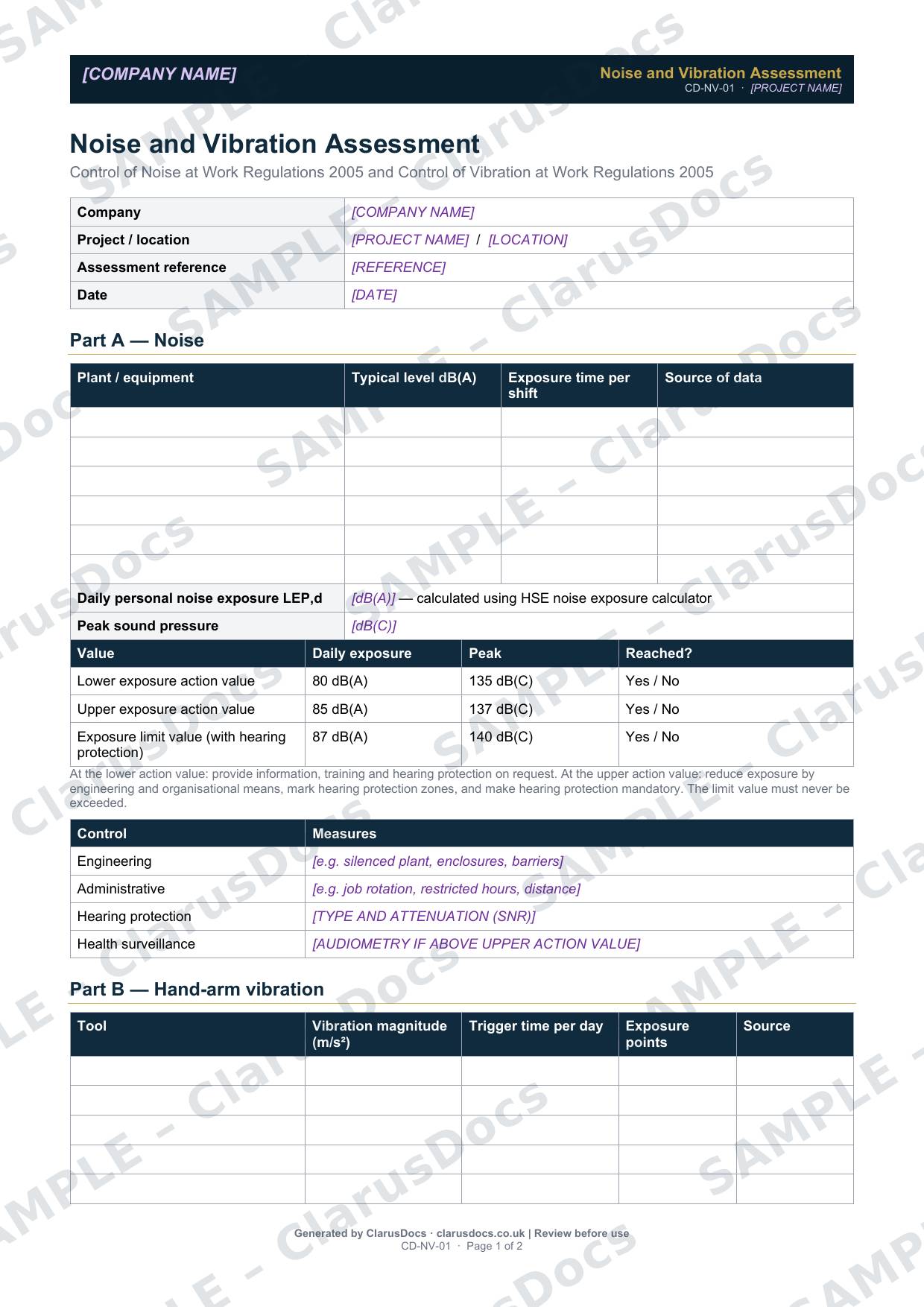
This noise and vibration risk assessment template works out daily noise exposure and hand-arm vibration exposure from the tools and plant used on site, compares them with the legal action and limit values, and records the controls and health surveillance needed.
 See what you get →
Completed except the facts only you know
£29 + VAT
£34.80 inc. VAT
- Fills in: Hazards, controls and risk scores before and after controls, for your task.
- Stays [TO CONFIRM]: Site address and postcode, nearest A&E, named people and contacts.
- A competent person must review before use.
- Company logo in header
- Delivered in minutes
- Word document (.docx)
Template
£12 + VAT
£14.40 inc. VAT
Blank assessment — fill in yourself
- Word document (.docx)
- Guidance notes included
- Instant download
- Use on any project
Prices exclude VAT: UK customers pay 20% VAT; VAT is not charged for customers outside the UK.All documents are drafts. Placeholders marked [TO CONFIRM] must be completed with your site-specific details. A competent person must review before use on site.
What it's for
Breakers, cut-off saws, compactors and other tools can cause permanent hearing loss and hand-arm vibration syndrome. The Control of Noise at Work Regulations 2005 and the Control of Vibration at Work Regulations 2005 require employers to assess exposure and act at set levels. The template puts both assessments in one document, with the values printed alongside.
When you need it
Before work involving noisy or vibrating tools or plant starts, and whenever the tools, the trigger times or the tasks change.
Who signs it
The assessor, who should be competent to estimate exposure, for example using HSE’s exposure calculators and manufacturers’ data.
What's inside
- Part A, noise: sources, levels, exposure times, the daily personal exposure and peak sound pressure
- The noise action and limit values: 80 and 85 dB(A) daily exposure action values, the 87 dB(A) limit, and the 135, 137 and 140 dB(C) peak values
- What to do at each level, plus noise controls, hearing protection and health surveillance
- Part B, hand-arm vibration: tools, vibration magnitudes, trigger times and exposure points
- The vibration exposure action value of 2.5 m/s² A(8) and limit value of 5.0 m/s² A(8)
- Vibration controls, health surveillance, training, sign-off and review
FAQ
- What are exposure points?
- A simple way of adding up vibration from different tools. In HSE’s points system, 100 points equals the exposure action value and 400 points equals the exposure limit value.
- Is hearing protection enough?
- Not at or above the upper action value. You must also reduce exposure by other means, such as quieter equipment, barriers or limiting time, and mark hearing protection zones.
- When is health surveillance needed?
- For vibration, where workers are likely to be regularly exposed above the action value. For noise, hearing checks are needed where workers are regularly exposed above the upper action value, or are at risk for another reason.
- What is [TO CONFIRM]?
- Details only you know, such as your site address and postcode, the nearest A&E, named people and contact numbers. We never guess these. They appear as highlighted [TO CONFIRM] placeholders, and the document opens with a list of every one, so you can fill them in before the assessment is signed and used.
- Can I edit the document?
- Yes. Both options are Word documents you can edit freely.
- Do I still need to review it?
- Yes. A competent person must check every document against the actual site and works before it is used. ClarusDocs gives you a complete first draft, not a substitute for that check.
Related documents
- COSHH Assessment TemplateAssess a hazardous substance before anyone uses it
- Manual Handling AssessmentAssess lifting and carrying tasks — task, load, environment, individual
- Working at Height Risk AssessmentPlan work at height the right way round: avoid, prevent, then minimise
- Construction Health and Safety Policy PackYour health and safety policy and arrangements, ready to tailor
- Lone Working Risk AssessmentPlan how someone working alone stays safe and in contact
- Young Persons Risk AssessmentThe extra assessment needed before anyone under 18 starts on site