Lone Working Risk Assessment Template
Written from experience on CTRL, Crossrail and Network Rail
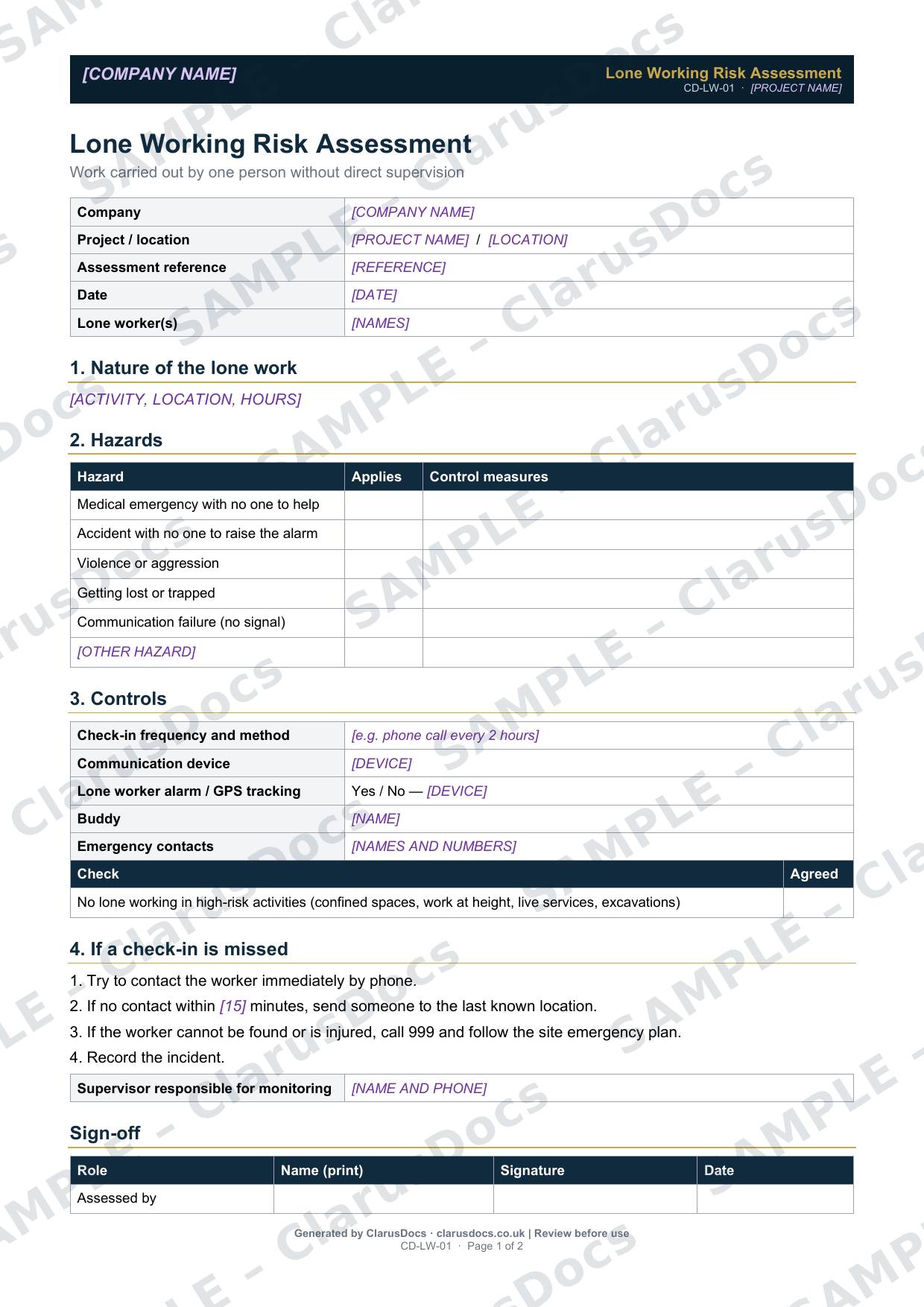
This lone working risk assessment template plans how someone working on their own stays safe and in contact: the hazards of working alone, how and when they check in, and exactly what happens if a check-in is missed.
 See what you get →
Completed except the facts only you know
£25 + VAT
£30 inc. VAT
- Fills in: Hazards, controls and risk scores before and after controls, for your task.
- Stays [TO CONFIRM]: Site address and postcode, nearest A&E, named people and contacts.
- A competent person must review before use.
- Company logo in header
- Delivered in minutes
- Word document (.docx)
Template
£9 + VAT
£10.80 inc. VAT
Blank assessment — fill in yourself
- Word document (.docx)
- Guidance notes included
- Instant download
- Use on any project
Prices exclude VAT: UK customers pay 20% VAT; VAT is not charged for customers outside the UK.All documents are drafts. Placeholders marked [TO CONFIRM] must be completed with your site-specific details. A competent person must review before use on site.
What it's for
Working alone is not illegal, but employers must assess the risks and put controls in place. The biggest danger is that an accident or medical emergency goes unnoticed. This template sets out the check-in arrangements, the communication devices and the escalation steps, and names the supervisor responsible for monitoring.
When you need it
Before anyone works alone without direct supervision, for example site security, early or late set-up, surveys, inspections or remote work. Review it if the work, the location or the person changes.
Who signs it
The assessor signs it. The lone worker signs to confirm they have been briefed.
What's inside
- The lone workers and the nature of the work: activity, location and hours
- A hazard table covering medical emergencies, accidents, violence, getting lost or trapped, and communication failure
- Controls: check-in frequency and method, communication device, lone worker alarm or GPS tracking, a buddy, and emergency contacts
- A rule that high-risk work is not done alone
- Four escalation steps if a check-in is missed
- The supervisor responsible, sign-off and review
FAQ
- Can someone enter a confined space or work in an excavation alone?
- The template treats confined spaces, work at height, live services and excavations as work that must not be done alone.
- How often should a lone worker check in?
- It depends on the risk. The template suggests an interval, such as every two hours, which you set to suit the work.
- What if there is no mobile signal?
- Record it as a hazard and choose another method, such as a satellite device or radio, or do not work alone at that location.
- What is [TO CONFIRM]?
- Details only you know, such as your site address and postcode, the nearest A&E, named people and contact numbers. We never guess these. They appear as highlighted [TO CONFIRM] placeholders, and the document opens with a list of every one, so you can fill them in before the assessment is signed and used.
- Can I edit the document?
- Yes. Both options are Word documents you can edit freely.
- Do I still need to review it?
- Yes. A competent person must check every document against the actual site and works before it is used. ClarusDocs gives you a complete first draft, not a substitute for that check.
Related documents
- New and Expectant Mothers Risk AssessmentThe assessment needed once a worker tells you she is pregnant or a new mother
- Display Screen Equipment (DSE) AssessmentCheck a computer workstation is set up properly for the person using it
- Drug and Alcohol PolicyA clear, fair drug and alcohol policy with testing and support
- COSHH Assessment TemplateAssess a hazardous substance before anyone uses it
- Manual Handling AssessmentAssess lifting and carrying tasks — task, load, environment, individual
- Noise and Vibration AssessmentWork out noise and vibration exposure from tools and plant, and what to do about it