Fatigue Management Plan
Written from experience on CTRL, Crossrail and Network Rail
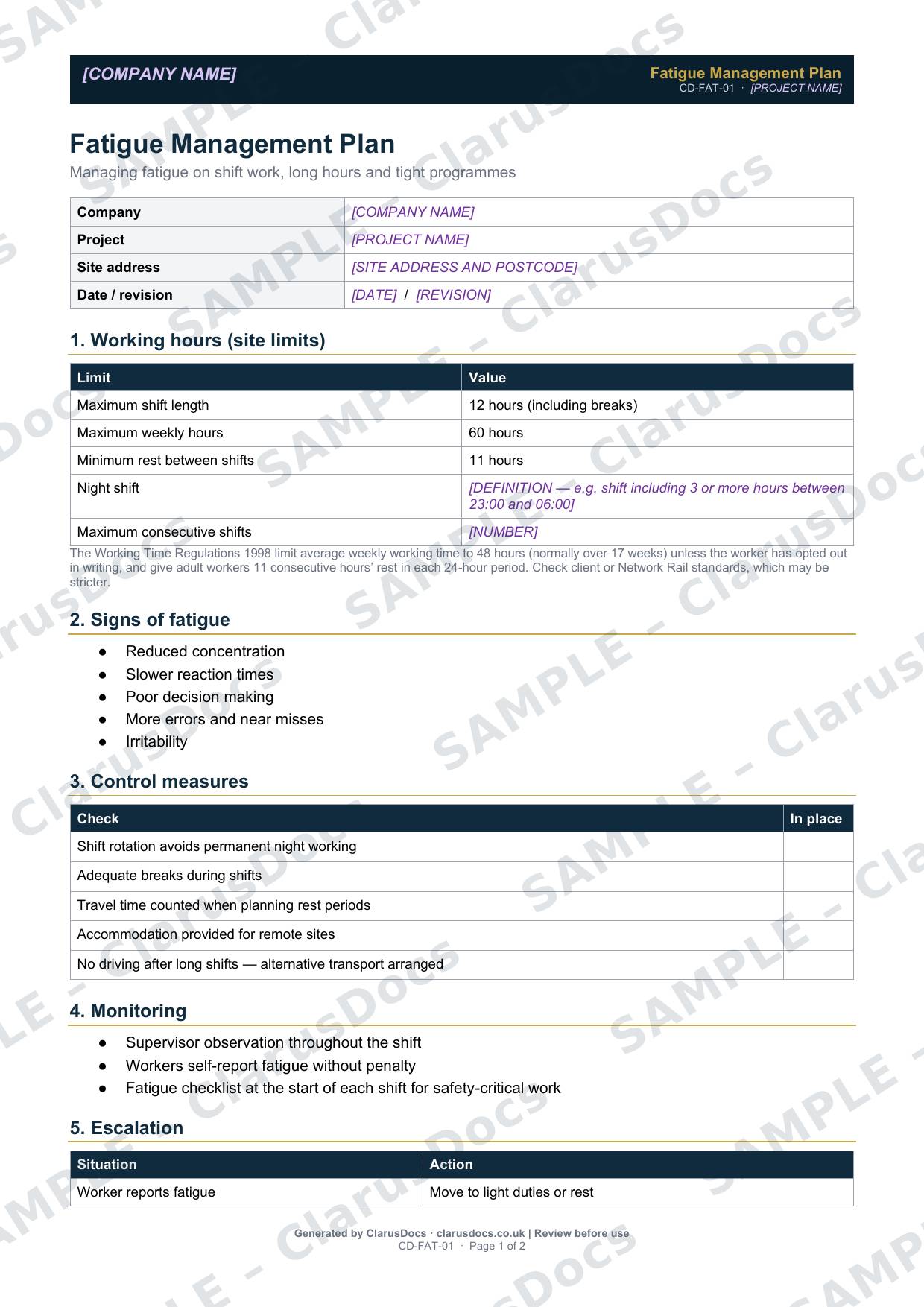
This fatigue management plan sets limits on working hours and explains how the site spots and deals with tiredness on projects with shift work, long hours or tight programmes: site hour limits, the signs of fatigue, controls, monitoring and escalation.
 See what you get →
Completed except the facts only you know
£25 + VAT
£30 inc. VAT
- Fills in: The plan and its arrangements for your project.
- Stays [TO CONFIRM]: Site address and postcode, nearest A&E, named people and contacts.
- A competent person must review before use.
- Company logo in header
- Delivered in minutes
- Word document (.docx)
Template
£9 + VAT
£10.80 inc. VAT
Blank plan — fill in yourself
- Word document (.docx)
- Guidance notes included
- Instant download
- Use on any project
Prices exclude VAT: UK customers pay 20% VAT; VAT is not charged for customers outside the UK.All documents are drafts. Placeholders marked [TO CONFIRM] must be completed with your site-specific details. A competent person must review before use on site.
What it's for
Tired people make mistakes, react more slowly and take more risks, on site and on the drive home. Fatigue is a risk to be assessed like any other. The plan sets clear site limits on hours and rest, and gives supervisors and workers a simple way to raise fatigue without penalty.
When you need it
On projects with shift work, night work, long hours, extended travel or a demanding programme, and whenever those conditions change.
Who signs it
The project manager.
What's inside
- Site limits on working hours: maximum shift length, maximum weekly hours, minimum rest between shifts, the night shift definition and maximum consecutive shifts
- A note on the Working Time Regulations 1998, and on client and Network Rail standards that may be stricter
- Signs of fatigue
- Controls: shift rotation, breaks, travel time, accommodation for remote sites, and no driving after long shifts
- Monitoring through supervisor observation, self-reporting and start-of-shift checks for safety-critical work
- An escalation table, with project manager approval needed in advance to exceed the limits
- Sign-off
FAQ
- What does the law say about working hours?
- The Working Time Regulations 1998 limit average weekly working time to 48 hours, normally averaged over 17 weeks, unless the worker opts out in writing. They also give adult workers 11 consecutive hours’ rest in each 24-hour period, and a rest break of at least 20 minutes when the working day is longer than six hours. Safety-critical work on the railway also has its own fatigue management duty under the Railways and Other Guided Transport Systems (Safety) Regulations 2006 (regulation 25).
- Are the template’s limits legal requirements?
- No. The shift and weekly limits in the template are site policy. Adjust them to your work, your client’s requirements and any industry standards that apply.
- Why count travel time?
- Long journeys before and after a shift add to fatigue and cut into rest, especially for workers who drive.
- What is [TO CONFIRM]?
- Details only you know, such as your site address and postcode, the nearest A&E, named people and contact numbers. We never guess these. They appear as highlighted [TO CONFIRM] placeholders, and the document opens with a list of every one, so you can fill them in before the plan is signed and used.
- Can I edit the document?
- Yes. Both options are Word documents you can edit freely.
- Do I still need to review it?
- Yes. A competent person must check every document against the actual site and works before it is used. ClarusDocs gives you a complete first draft, not a substitute for that check.
Related documents
- Permit to DigSign-off that buried services are found and marked before anyone breaks ground
- Hot Works PermitApproval for welding, cutting or grinding, with the fire watch afterwards
- Permit to AccessApproval to work in a client's or tenant's premises, applied for 24 hours ahead
- Early Warning NoticeThe notice that flags a problem early, before it costs time or money
- Stakeholder Notification LogShow who was told about the works, when and how
- Site Instruction LogLog every instruction now — so you can claim it later