Permit to Dig Template for Buried Services
Written from experience on CTRL, Crossrail and Network Rail
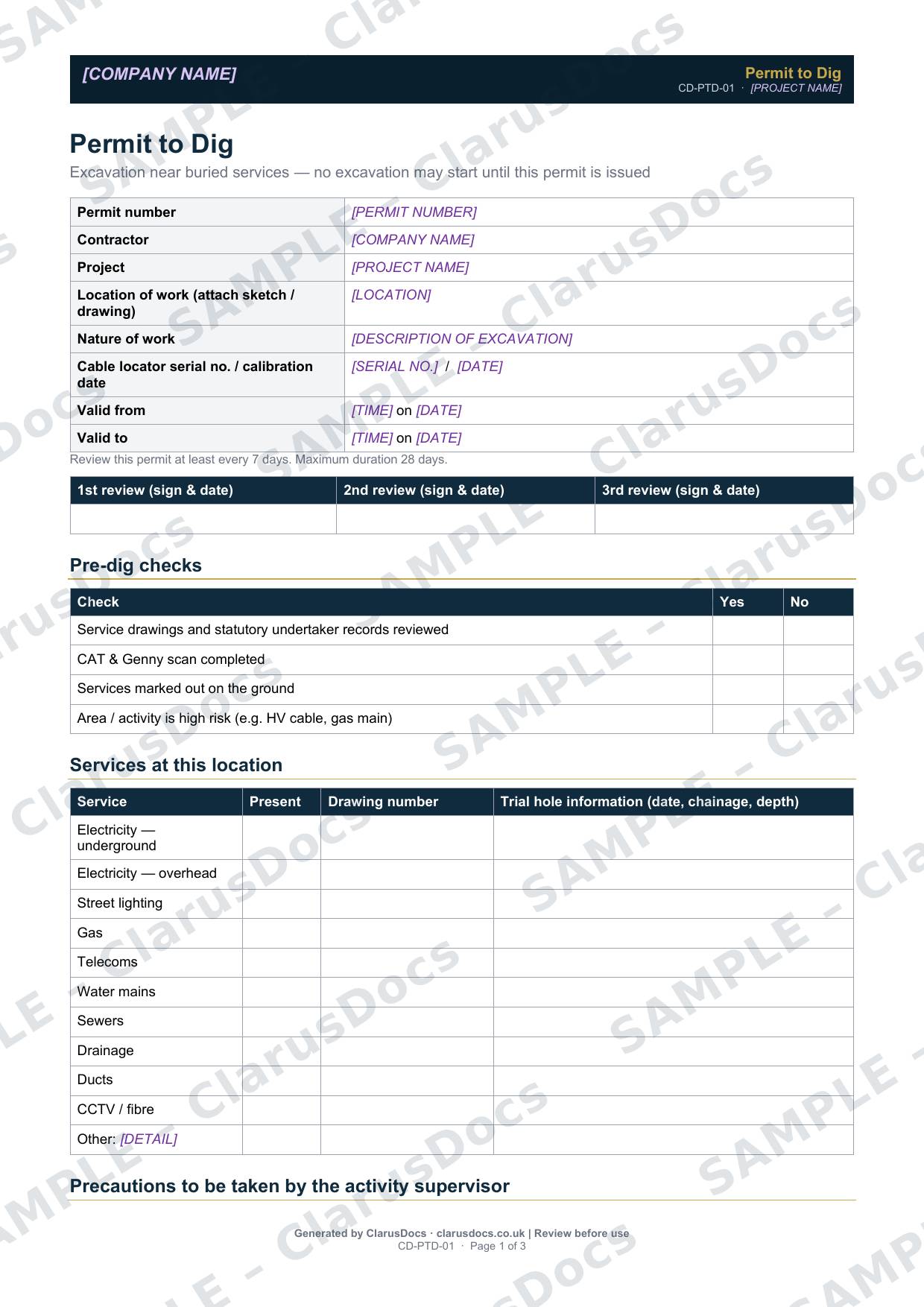
This permit to dig template stops anyone breaking ground until the buried services at that spot have been checked, located and marked. It records the drawings that were reviewed, the cable locator used, the services found, and who allowed the digging to go ahead.
 See what you get →
Completed except the facts only you know
£25 + VAT
£30 inc. VAT
- We fill in from your answers: the permit details, from the works you describe.
- Stays [TO CONFIRM]: the site facts only you know: permit number, named issuers and emergency contacts. Signatures, times and readings are left blank for issue.
- A competent person reviews and signs it before use.
Template
£9 + VAT
£10.80 inc. VAT
Blank permit — fill in yourself
- Word document (.docx)
- Guidance notes included
- Instant download
- Use on any project
Prices exclude VAT: UK customers pay 20% VAT; VAT is not charged for customers outside the UK.All documents are drafts. Placeholders marked [TO CONFIRM] must be completed with your site-specific details. A competent person must review before use on site.
Why it matters
When the dispute arrives, the question is always: what did you have in place and when? This document is the answer.
What it's for
HSE guidance HSG47 sets out a safe system of plans, locating and safe digging. A permit to dig puts that system on one page, so it is clear that it happened before anyone dug, not reconstructed afterwards.
When you need it
Before any excavation, trial hole, post hole or ground penetration where buried services could be present. It is issued for a specific location, valid for up to 28 days, and reviewed at least every 7 days.
Who signs it
The permit moves through five stages, and each one is signed:
- the engineer issues it once precautions are identified
- the client authorises it
- the supervisor receives it and briefs the gang
- the site manager authorises full excavation once every service is located
- the permit coordinator closes it when the area is left safe
Until the “authorised to commence” box is signed, only hand-dug trial holes are allowed.
What's inside
- Permit details, location, validity and cable locator calibration
- Pre-dig checks: drawings, CAT and Genny scan, mark-out, high-risk services
- A table of eleven service types, with drawing numbers and trial hole findings
- Supervisor precautions, including hand digging with insulated tools
- The template requires hand digging within 500mm of a known service, unless the permit allows another safe method such as vacuum excavation.
- Signed permit stages, a sketch area and a briefing record
FAQ
- Do I need a permit for a small hole, like a fence post?
- Our template treats any hole where services could be present the same way, whatever its size.
- How long does a permit to dig last?
- This template allows up to 28 days, with a review at least every 7 days. Cancel it and issue a new one if the location or scope changes.
- Do I still need a CAT scan if I have the utility drawings?
- Yes. Drawings show approximate positions only, and many services are not on them. Scanning, marking and trial holes are all needed.
- What if we hit a service?
- Stop, get everyone clear, do not touch the damaged apparatus, and call the utility’s emergency number and your site manager.
- What is [TO CONFIRM]?
- Details only you know, such as the permit number, named issuers and emergency contacts. We never guess these. They appear as highlighted [TO CONFIRM] placeholders, and the permit opens with a list of every one. Signatures, times and readings are left blank, to be completed when the permit is issued.
- Can I edit the document?
- Yes. Both options are Word documents you can edit freely.
- Do I still need to review it?
- Yes. A competent person must check every document against the actual site and works before it is used. ClarusDocs gives you a complete first draft, not a substitute for that check.
Related documents
- Hot Works PermitApproval for welding, cutting or grinding, with the fire watch afterwards
- Confined Space PermitApproval to enter manholes and chambers, with gas checks and a rescue plan
- Permit to AccessApproval to work in a client's or tenant's premises, applied for 24 hours ahead
- Excavation Safety Toolbox TalkA ten-minute briefing on trench safety, with a sign-on sheet for the gang
- Stakeholder Notification LogShow who was told about the works, when and how
- Pre-Start Work Package ChecklistCheck everything is ready before a package starts — not after