Hot Works Permit Template
Written from experience on CTRL, Crossrail and Network Rail
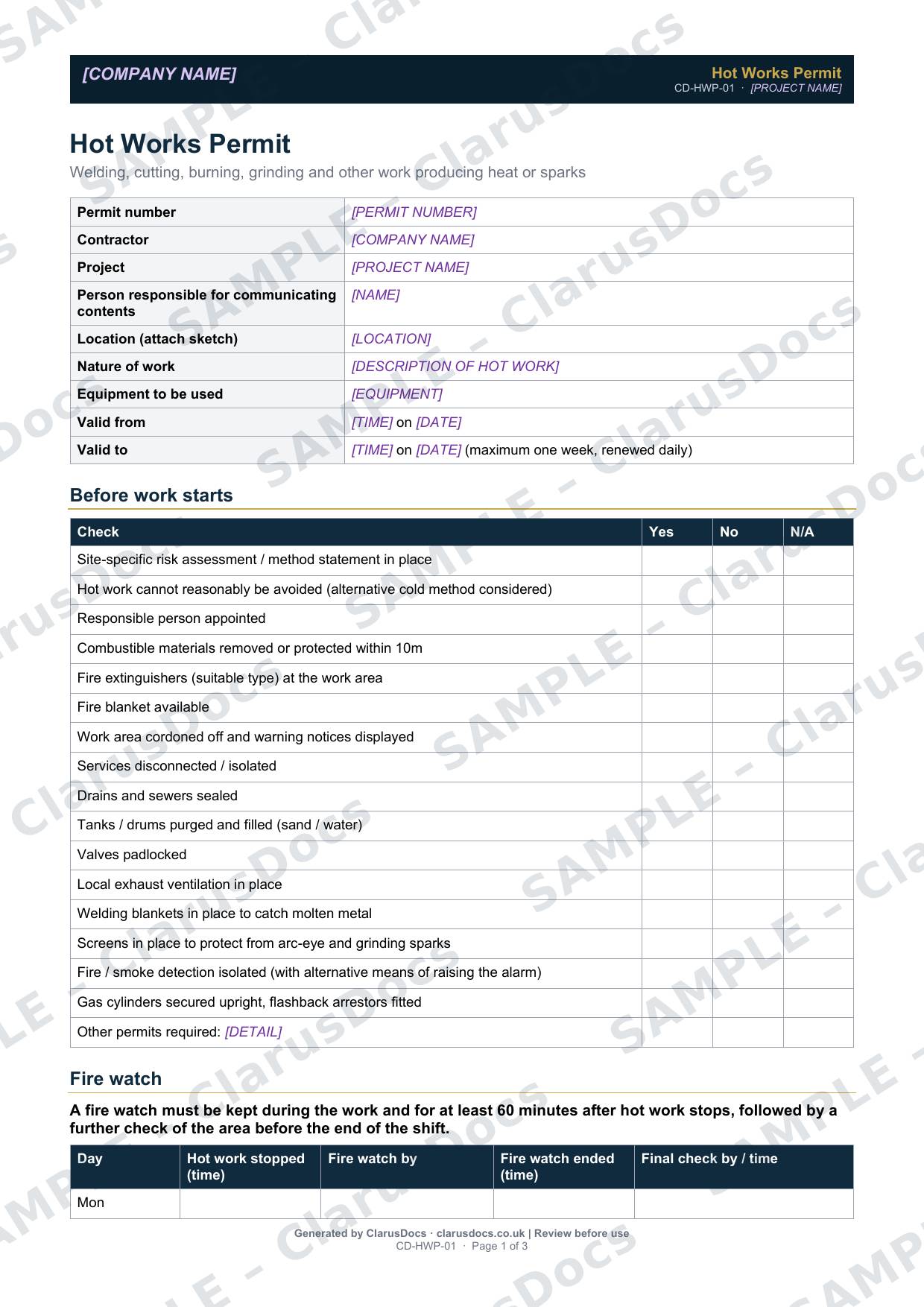
This hot works permit template controls welding, cutting, burning, grinding and any other work that produces heat or sparks. It records the precautions taken before work starts and the fire watch after it stops.
 See what you get →
Completed except the facts only you know
£25 + VAT
£30 inc. VAT
- Fills in: The permit details, from the works you describe.
- Stays [TO CONFIRM]: Permit number, named issuers and emergency contacts. Signatures, times and readings are left blank for issue.
- A competent person must review before use.
- Company logo in header
- Delivered in minutes
- Word document (.docx)
Template
£9 + VAT
£10.80 inc. VAT
Blank permit — fill in yourself
- Word document (.docx)
- Guidance notes included
- Instant download
- Use on any project
Prices exclude VAT: UK customers pay 20% VAT; VAT is not charged for customers outside the UK.All documents are drafts. Placeholders marked [TO CONFIRM] must be completed with your site-specific details. A competent person must review before use on site.
Why it matters
When the dispute arrives, the question is always: what did you have in place and when? This document is the answer.
What it's for
Hot work is a common cause of fires on construction sites and in occupied buildings, and a fire can start long after the work has finished. A permit makes someone confirm that combustibles are cleared or protected, extinguishers are in place and a fire watch is kept, before any hot work starts.
When you need it
Before any hot work, including welding, gas cutting, burning, grinding, brazing and the use of blow torches, unless a safer cold method can be used. It is valid for up to one week and renewed daily.
Who signs it
The issuer signs to confirm the precautions are in place. The contractor’s representative accepts responsibility for the work area. The issuer cancels it once the fire watch is complete and the area has been inspected. The fire watch for each day is signed off in the daily table.
What's inside
- Permit details, location, work and equipment
- A 17-point precautions checklist, including combustibles within 10m, extinguishers, isolation of detectors, drains sealed and gas cylinders secured
- A fire watch rule: during the work and for at least 60 minutes after it stops, then a final check before the end of the shift
- A daily fire watch log from Monday to Sunday
- PPE requirements, emergency contacts and the nearest fire alarm call point
- Signed permit stages and a briefing record
FAQ
- How long should the fire watch last?
- This template requires at least 60 minutes after hot work stops, followed by a further check before the end of the shift. Your insurer or client may require longer.
- Does grinding count as hot work?
- Yes. Grinding produces sparks that can travel a long way and smoulder unseen.
- Can I isolate the fire alarm?
- Only if there is another way to raise the alarm. The checklist includes this point.
- What is [TO CONFIRM]?
- Details only you know, such as the permit number, named issuers and emergency contacts. We never guess these. They appear as highlighted [TO CONFIRM] placeholders, and the permit opens with a list of every one. Signatures, times and readings are left blank, to be completed when the permit is issued.
- Can I edit the document?
- Yes. Both options are Word documents you can edit freely.
- Do I still need to review it?
- Yes. A competent person must check every document against the actual site and works before it is used. ClarusDocs gives you a complete first draft, not a substitute for that check.
Related documents
- Permit to DigSign-off that buried services are found and marked before anyone breaks ground
- Confined Space PermitApproval to enter manholes and chambers, with gas checks and a rescue plan
- Permit to AccessApproval to work in a client's or tenant's premises, applied for 24 hours ahead
- Permit to PumpApproval to pump out water, with where it goes and how silt is controlled
- Early Warning NoticeThe notice that flags a problem early, before it costs time or money
- Stakeholder Notification LogShow who was told about the works, when and how