Confined Space Permit to Work Template
Written from experience on CTRL, Crossrail and Network Rail
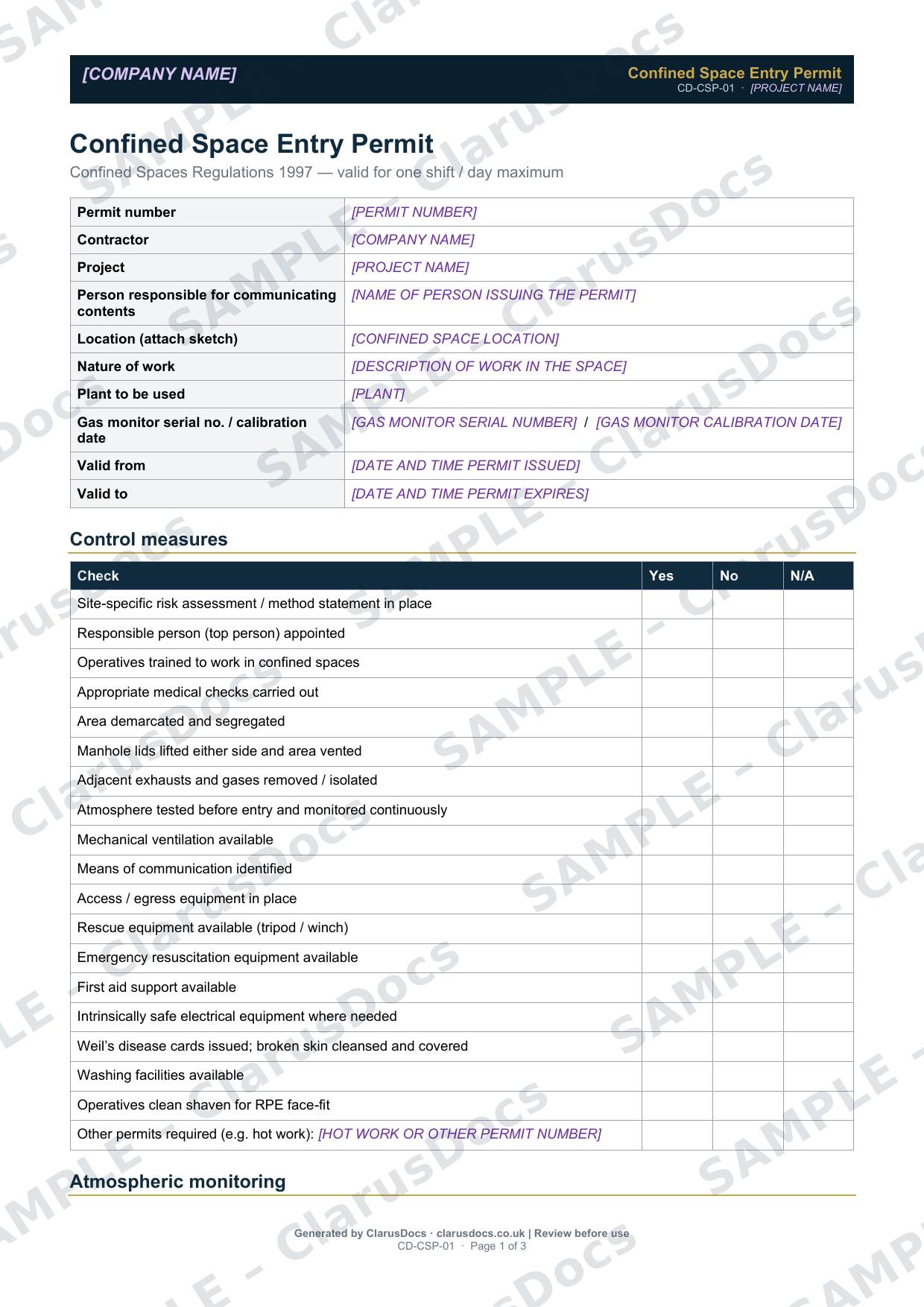
This confined space permit to work template controls entry into manholes, chambers, tanks and other confined spaces. Before anyone goes in, it records the control measures in place, atmospheric test results, rescue arrangements and the people inside.
 See what you get →
Completed except the facts only you know
£35 + VAT
£42 inc. VAT
- Fills in: The permit details, from the works you describe.
- Stays [TO CONFIRM]: Permit number, named issuers and emergency contacts. Signatures, times and readings are left blank for issue.
- A competent person must review before use.
- Company logo in header
- Delivered in minutes
- Word document (.docx)
Template
£12 + VAT
£14.40 inc. VAT
Blank permit — fill in yourself
- Word document (.docx)
- Guidance notes included
- Instant download
- Use on any project
Prices exclude VAT: UK customers pay 20% VAT; VAT is not charged for customers outside the UK.All documents are drafts. Placeholders marked [TO CONFIRM] must be completed with your site-specific details. A competent person must review before use on site.
Why it matters
When the dispute arrives, the question is always: what did you have in place and when? This document is the answer.
What it's for
Confined spaces can kill quickly through lack of oxygen, toxic or flammable gas, or drowning, and would-be rescuers are often among the victims. The Confined Spaces Regulations 1997 require entry to be avoided where reasonably practicable, and otherwise to follow a safe system of work with emergency arrangements in place. HSE’s Approved Code of Practice L101, Safe work in confined spaces, gives guidance on these regulations. A permit is a common way to make sure the system is followed every time.
When you need it
For every entry into a confined space, for example sewer manholes, inspection chambers, tanks, culverts and deep excavations where the atmosphere may be dangerous. It is valid for one shift or one day at most.
Who signs it
The issuer signs to confirm the controls are in place. The contractor’s representative signs to accept responsibility for the work and the RAMS. The issuer cancels the permit when everyone is out and the area is safe. Everyone involved signs the briefing record.
What's inside
- Permit details, location, work, plant and gas monitor calibration
- A 19-point control checklist, including the top person, training, ventilation, continuous gas monitoring, rescue equipment and Weil’s disease cards
- An atmospheric monitoring log for oxygen, flammable gas, hydrogen sulphide and carbon monoxide
- PPE requirements, including respiratory protection and escape sets
- Emergency and rescue details, and an entrant register with times in and out
- Signed permit stages and a briefing record
FAQ
- Is the permit enough on its own?
- No. Use it with a task-specific risk assessment and method statement and a rescue plan.
- What gas levels should the alarms be set to?
- The template shows typical alarm levels. Use the levels set in your risk assessment and your gas monitor’s configuration.
- How long is the permit valid?
- One shift or one day at most. Issue a new permit for each shift.
- What is [TO CONFIRM]?
- Details only you know, such as the permit number, named issuers and emergency contacts. We never guess these. They appear as highlighted [TO CONFIRM] placeholders, and the permit opens with a list of every one. Signatures, times and readings are left blank, to be completed when the permit is issued.
- Can I edit the document?
- Yes. Both options are Word documents you can edit freely.
- Do I still need to review it?
- Yes. A competent person must check every document against the actual site and works before it is used. ClarusDocs gives you a complete first draft, not a substitute for that check.
Related documents
- Permit to DigSign-off that buried services are found and marked before anyone breaks ground
- Hot Works PermitApproval for welding, cutting or grinding, with the fire watch afterwards
- Permit to AccessApproval to work in a client's or tenant's premises, applied for 24 hours ahead
- Permit to PumpApproval to pump out water, with where it goes and how silt is controlled
- Drainage Excavation RAMSThe method statement and risk assessment for digging trenches and laying drains
- Confined Space Risk AssessmentStarts with the first question: can entry be avoided?