Heat Stress Management Plan
Written from experience on CTRL, Crossrail and Network Rail
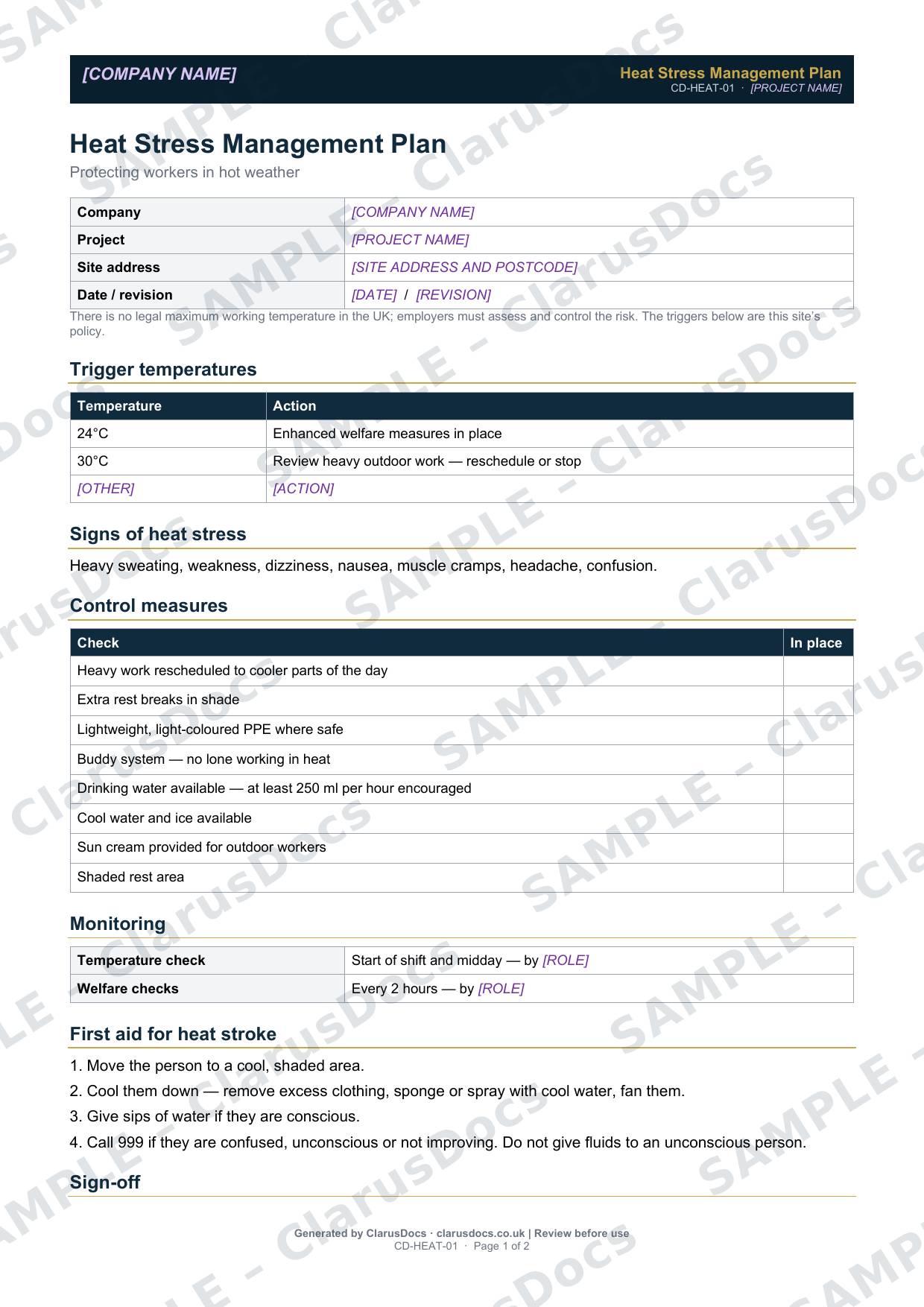
This heat stress management plan sets out what the site does when it gets hot: trigger temperatures, the signs of heat stress, control measures, monitoring, and first aid for heat stroke.
 See what you get →
Completed except the facts only you know
£25 + VAT
£30 inc. VAT
- Fills in: The plan and its arrangements for your project.
- Stays [TO CONFIRM]: Site address and postcode, nearest A&E, named people and contacts.
- A competent person must review before use.
- Company logo in header
- Delivered in minutes
- Word document (.docx)
Template
£9 + VAT
£10.80 inc. VAT
Blank plan — fill in yourself
- Word document (.docx)
- Guidance notes included
- Instant download
- Use on any project
Prices exclude VAT: UK customers pay 20% VAT; VAT is not charged for customers outside the UK.All documents are drafts. Placeholders marked [TO CONFIRM] must be completed with your site-specific details. A competent person must review before use on site.
What it's for
Heavy work in hot weather, especially in PPE, can lead to dehydration, heat exhaustion and heat stroke, as well as sunburn and lapses in concentration. There is no legal maximum working temperature in the UK, but employers must assess the risk and control it. The plan sets clear triggers so the site acts before people get ill.
When you need it
Before the summer, and whenever hot weather is forecast. Review it each year.
Who signs it
The site manager.
What's inside
- A note that there is no legal maximum working temperature, and that the triggers are site policy
- Trigger temperatures and actions, starting at 24°C
- Signs of heat stress
- An eight-point control checklist, including rescheduling heavy work, extra breaks in shade, suitable PPE, a buddy system, drinking water, sun cream and a shaded rest area
- Monitoring: temperature checks and welfare checks, with who carries them out
- First aid for heat stroke
- Sign-off
FAQ
- Is there a maximum temperature for working outside?
- No. Employers must assess and control the risks. The plan’s trigger temperatures are site policy, which you can adjust.
- Can PPE be relaxed in hot weather?
- Only where it is safe to do so. The plan suggests lightweight, light-coloured PPE where that does not reduce protection.
- When should I call 999?
- If the person is confused, unconscious or not improving. Do not give fluids to an unconscious person.
- Why use a buddy system in hot weather?
- People with heat stress do not always notice the signs in themselves. Working in pairs means someone is watching for confusion, dizziness or other symptoms and can raise the alarm.
- What is [TO CONFIRM]?
- Details only you know, such as your site address and postcode, the nearest A&E, named people and contact numbers. We never guess these. They appear as highlighted [TO CONFIRM] placeholders, and the document opens with a list of every one, so you can fill them in before the plan is signed and used.
- Can I edit the document?
- Yes. Both options are Word documents you can edit freely.
- Do I still need to review it?
- Yes. A competent person must check every document against the actual site and works before it is used. ClarusDocs gives you a complete first draft, not a substitute for that check.
Related documents
- Site Wellbeing PlanShow how the site looks after people’s physical and mental health
- Cold Weather Working PlanWhat the site does in the cold — for people, concrete and frozen ground
- Fatigue Management PlanLimits on hours and how the site spots and deals with tiredness
- Lone Working Risk AssessmentPlan how someone working alone stays safe and in contact
- New and Expectant Mothers Risk AssessmentThe assessment needed once a worker tells you she is pregnant or a new mother
- Display Screen Equipment (DSE) AssessmentCheck a computer workstation is set up properly for the person using it