Method Statement Template
Written from experience on CTRL, Crossrail and Network Rail
This method statement template is the method only: how a construction task will be done, step by step, in the order it happens. It sets out the scope, the people and their competence, plant and equipment, permits, the method with its controls and hold points, PPE, emergency arrangements and the briefing record. It has no risk assessment: read it with a separate one, or use the RAMS template to have both in one document.
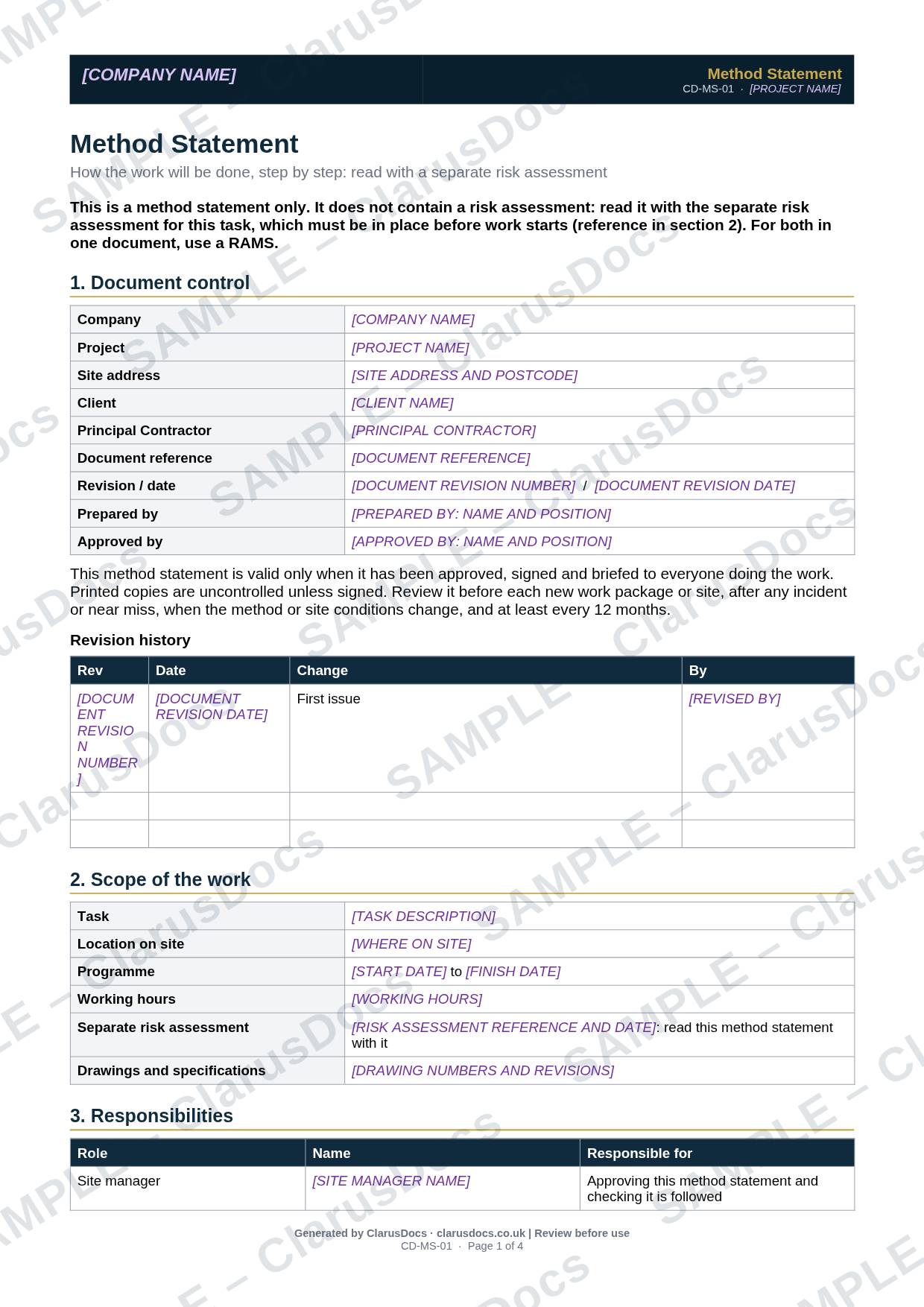 See what you get →
Template
£9 + VAT
£10.80 inc. VAT
Blank RAMS — fill in yourself
- Word document (.docx)
- Guidance notes included
- Instant download
- Use on any project
Prices exclude VAT: UK customers pay 20% VAT; VAT is not charged for customers outside the UK.All documents are drafts. Complete the placeholders with your own details, and have a competent person review them before use.
Why it matters
When the dispute arrives, the question is always: what did you have in place and when? This document is the answer.
What it's for
A method statement turns a plan into instructions the gang can follow. It shows the client and principal contractor how you will do the job, and gives the supervisor something to brief and check against. It is read with the risk assessment for the task, which it references.
When you need it
Before a task starts, especially where the client or principal contractor asks for one, or the work is high risk or new to the team. Revise it when the method changes.
Who signs it
The person who prepared it and the site manager who approves it. Everyone doing the work signs the briefing record.
What's inside
- Document control and revision history
- Scope of the work, and the reference of the separate risk assessment it is read with
- Responsibilities, and the competence each role needs
- Plant, equipment and materials, with pre-use checks
- Access, segregation, welfare and permits
- Step-by-step method with controls and hold points
- Inspections and when to stop work
- PPE and emergency arrangements
- Briefing record and sign-off
- No risk assessment: it is read with a separate one
FAQ
- Is a method statement a legal requirement?
- No law names a method statement. The legal duties are to assess the risks (Management of Health and Safety at Work Regulations 1999, regulation 3) and, for contractors, to plan, manage and monitor the work (CDM 2015, regulation 15). A method statement is a common way of planning and briefing the work, and clients and principal contractors often ask for one.
- What is the difference between this and the RAMS template?
- This template is the method only. The RAMS template has the same kind of method plus a full risk assessment (hazards, who might be harmed, risk before and after controls, controls in hierarchy order) in one document. Use this one when the risk assessment is a separate document, for example your company’s own; otherwise use the RAMS.
- Does this method statement include a risk assessment?
- No. The law requires a suitable and sufficient risk assessment (Management of Health and Safety at Work Regulations 1999, regulation 3), so read this method statement with a separate one and put its reference in section 2. The controls in the method should come from that risk assessment.
- How detailed should the steps be?
- Detailed enough that someone new to the team could follow them. Each step should say what is done, who does it, and the controls or checks that apply.
- Who should write it?
- Someone who knows the task and the site, usually the supervisor or site manager, with input from the people doing the work.
- What are the [PLACEHOLDERS]?
- Purple text in square brackets, such as [COMPANY NAME], marks the details you fill in. Replace each one with your own details, and remove anything that doesn’t apply, before the document is used.
- Can I edit the document?
- Yes. It’s a Word document you can edit freely.
- Do I still need to review it?
- Yes. A competent person must check every document against the actual site and works before it is used. ClarusDocs gives you a complete first draft, not a substitute for that check.
Example: steps from a method statement
Part of the method for installing a precast manhole.
Example only: illustrative content, not from a real project.
| Step | What is done | Who | Controls and hold points |
|---|---|---|---|
| 3 | Excavate to formation level inside the trench box | Excavator operator, banksman | Permit to dig in place; box installed as dug; exclusion zone around the excavator |
| 4 | Lay and level the concrete base | Two operatives | Hold point: supervisor checks level and depth before rings are placed |
| 5 | Lift rings into place with the excavator in lifting mode | Operator, slinger signaller | Lift plan briefed; accessories checked; no one under the load |
How to write a method statement
- Describe the task, where it is, and reference the risk assessment.
- Name who is responsible for what, and the competence each role needs.
- List the plant, equipment and materials, and the checks before use.
- Write the method step by step, as the work will actually be done.
- Add the controls and hold points for each step, and when to stop work.
- Have it approved, then brief it and collect signatures before work starts.
Related documents
- RAMS TemplateMethod statement and full risk assessment, in one document
- COSHH Assessment TemplateAssess a hazardous substance before anyone uses it
- Manual Handling AssessmentAssess lifting and carrying tasks — task, load, environment, individual
- Noise and Vibration AssessmentWork out noise and vibration exposure from tools and plant, and what to do about it
- Working at Height Risk AssessmentPlan work at height the right way round: avoid, prevent, then minimise
- Construction Health and Safety Policy PackYour health and safety policy and arrangements, ready to tailor